

REVIEW: Moline Playcrafters’ Powerful “Diary of Anne Frank” Electrifies With New, Disturbing Relevance
Walking into see the new production of Playcrafters Barn Theatre’s “The Diary of Anne Frank,” I knew I was in for a riveting, heart-rending drama that would not simply be a decades-old tragedy with no relevance to today.
Seeing the Saturday, Aug. 2 performance — directed with precision, flair and profound humanity by Elle Winchester – I did not know I’d share her laser focus on the parallel between the Holocaust of World War II to today’s deeply disturbing U.S. deportation of immigrants, with the show taking place just two days before the 81st anniversary of the Nazi Gestapo’s arrest of the Frank family and four others in Amsterdam hiding in their Secret Annex.
President Trump (clearly a wannabe dictator, with a callous disregard for most people who aren’t white) has called for the largest mass deportation of immigrants in history and has not only moved to send criminals out of the country, but has singled out families (including children who are American citizens) in the midst of court proceedings in their attempt to live here legally, and in many cases have fled violence, poverty or persecution in their home countries.
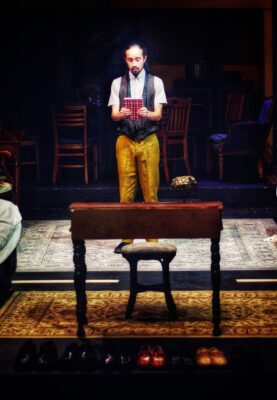
Esteban Lopez plays the father, Otto Frank.
In a painful, insightful director’s note to the Playcrafters production (the 1997 adaptation by Wendy Kesselman of the original 1955 Pulitzer-winning play by Frances Goodrich and Albert Hackett), Winchester wrote that as the U.S. “becomes a fascist regime, it is more important now than ever that we remember Anne Frank and her story.”
“When ICE runs rampant in our streets, arresting and disappearing immigrants without cause or due process, we must not forget that at one point…” Anne Frank’s very existence was also illegal, as Adolf Hitler’s Nazi war machine brutally rounded up millions upon millions of Jews, killing six million of them in concentration camps. In “The Diary of Anne Frank,” we learn the 15-year-old heroine of the true story perished from disease with her sister and mother (in February or March 1945), and her father Otto miraculously was liberated from Auschwitz Jan. 27, 1945, and was able to retrieve her diary, bringing her optimistic, prescient voice to the world.
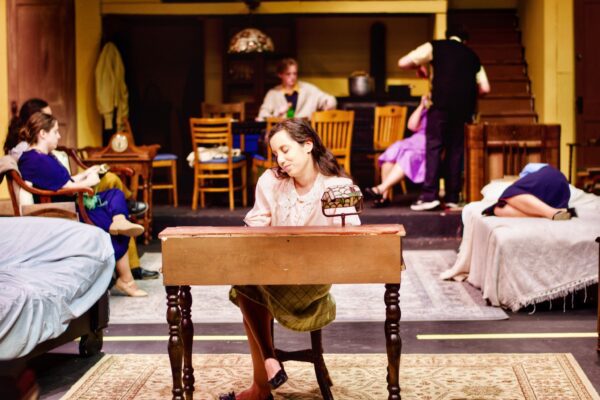
Emma Terronez (center) stars in “The Diary of Anne Frank” at Playcrafters, Moline.
“As the United States sends immigrants to foreign concentration camps barely disguised as prisons without due process, we must remember that Anne Frank and millions of others were forced from their homes, families and lives, deported into camps across Europe to be immediately executed or worked to death,” Playcrafters’ Winchester wrote for the program.
She makes note of the cruel “Alligator Alcatraz” detention center for immigrants in Florida, and the 66 million-plus Hispanics now in the U.S., with the warning call today “that we rise up and stop these atrocities from ever happening again.”
I can’t imagine that it was coincidence that Winchester cast the two most vital roles in “Diary of Anne Frank” – the title character and her father Otto, played indelibly by actors of Hispanic heritage, Emma Terronez and Esteban Lopez.
I don’t think this belittles or trivializes the unimaginable horror faced by Jews during the war, but the director seems to want to link the current challenges faced by many immigrants to what European Jews faced over 80 years ago. And Winchester is not the first to do so – director Stan Zimmerman also staged Kesselman’s version (which focused more on Anne and then-newly discovered writing from the diary) in Los Angeles in 2018, with a mostly Latino cast, repeated later in southern California.
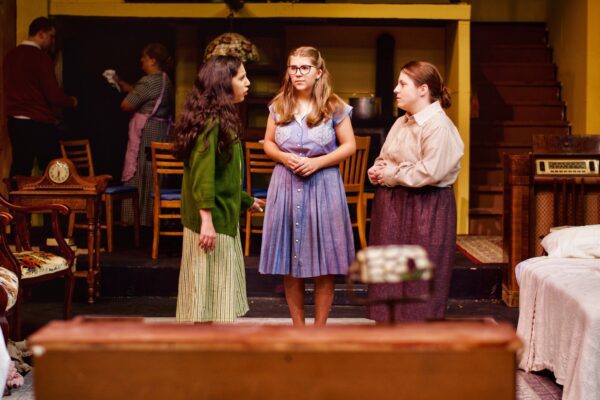
Emma Terronez, left, plays Anne, Kaitlyn Knepper is Margot, and Jonna Hicks-Bird plays their mother Edith Frank.
While Playcrafters’ eight occupants of the Secret Annex, with a second-floor attic, are not mostly Latino, a comparable point is strongly and chillingly made.
Terronez is strikingly similar in appearance to Anne (who begins the story at age 13 in 1942), and effectively embodies her boundless idealism, her dreams of becoming a writer, her dramatic pluck and intense emotions. Lopez – a veteran Chicago actor who recently earned a theater degree from Knox College in Galesburg – is the solid rock and foundation of this constantly shifting situation. He carries himself with admirable moral authority and compassionate, parental love.
The meaning and beauty of “The Diary of Anne Frank” is not simply that it documents pivotal moments in world history, but it gives names and faces to the countless victims of Nazi atrocities, the worst that human beings can inflict on each other.
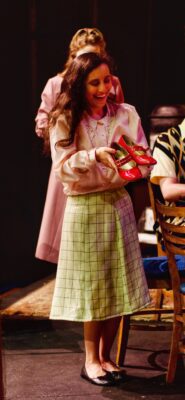
Emma Terronez as Anne gets a pair of new shoes.
While still developing as a teenager (she notes her first periods, her wishing for a true friend and a first kiss), Anne is wise and mature beyond her years. In a summary of Kesselman’s adaptation, Anne is described as a “living, lyrical, intensely gifted young girl who confronts her rapidly changing life and the increasing horror of her time with astonishing honesty, wit and determination.”
Her diary captures the mundane reality, annoyances, frustrations and fears of eight people sharing a 450-square-foot space, and the Playcrafters stage design (by Jaina Gliva and Chris Sambdman) incorporates several scrawled excerpts from the diary covering the walls, though it’s nearly impossible to make out what they say.
Lillian Dawn and Drew DeKeyrel play the good-hearted Dutch citizens Miep Gies and Mr. Kraler, who assist the Jews in hiding – including Jonna Hicks-Bird as Anne’s mother Edith; Kaitlyn Knepper as Anne’s more modest, quiet sister Margot; Michael Kintigh as Peter Van Daan; Victor Angelo and Amanda Wilson as his parents, and Keegan Walker as the temperamental dentist Mr. Dussel, who joins the group a few months into their 25-month stay in the Secret Annex.

The Frank family played by (L-R) Jonna Hicks-Bird, Kaitlyn Knepper, Esteban Lopez and Emma Terronez.
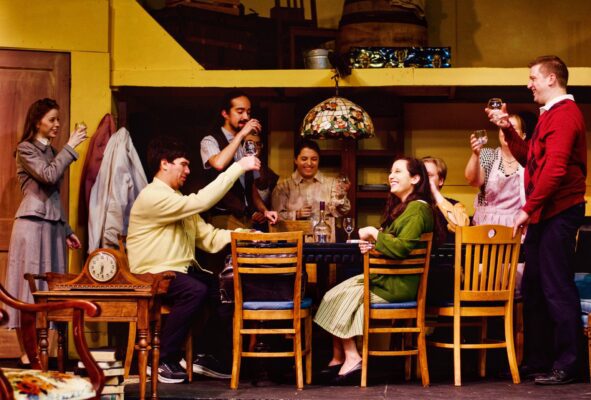
Life is not all misery during the play, as in the first act, the group celebrates one night of Hanukkah, lighting candles at their menorah, Anne passes out presents to each (including a scarf she knitted for her father), and they softly sing “Rock of Ages” in Hebrew. At one point in the second act, Peter calls Anne pretty and she’s ecstatic – proceeding to dance and twirl around. She infectiously longs for everything, and reveals a voracious appetite for life.
After the D-Day invasion by the Allies in June 1944, Miep rushes in to give them the good news, and listening to the radio, they anxiously dream of their day of liberation. Soon after, when three Nazis burst into the annex to capture them (Aug. 4, 1944), and as the cast is frozen in place, we hear Anne’s declaration that “In spite of everything, people are good at heart.”
One of the most gripping parts of the play is Lopez’s tortured monologue at the end, as each Jewish victim holds a candle at the front of the stage and he describes what happened to them.
We often to go to the theater for a blissful escape from our day-to-day cares, a distraction for two hours. But “The Diary of Anne Frank” forces us to confront our cares and troubles, to consider the plight of others. Anne said in her diary: “When I write, I shake off all of my cares. But I want to achieve more than that. I want to be useful and bring enjoyment to all people, even those I’ve never met. I want to go on living even after my death!”
She certainly has, offering a shining example for the rest of us.
“The Diary of Anne Frank” continues at Playcrafters (4950 35th Ave., Moline) at 7:30 p.m. Friday and Saturday, Aug. 8 and 9, and 3 p.m. Sunday, Aug. 10. Tickets are $18, or $16 for seniors and military, available at 309-762-0330 or playcrafters.com.

The play is a 1997 Wendy Kesselman adaptation of the 1955 Pulitzer winner by Frances Goodrich and Albert Hackett.











Leave a Reply
You must be logged in to post a comment.