

Quad Cities Public Media Bracing for Loss in Federal Funding
The loss of federal funding for public radio and public TV will mean WQPT-PBS would lose over half of its budget, and WVIK Quad Cities NPR would face a 13-percent cut in its annual revenue.
Public media stations nationwide have been battling to save government funding of the Corporation for Public Broadcasting, which provides a small part of national PBS and NPR programming, but is a major funder of local stations across the country.
The Senate early Thursday approved the Rescissions Act with devastating cuts that would cancel $1.1 billion in public media funding already signed into law, according to the website protectmypublicmedia.org.
It’s part of a request from President Donald Trump to take back $9 billion in funds that Congress already appropriated for foreign aid and public broadcasting. Trump sent the request to Congress June 3, and it passed the House later that month. The Senate passed an amended version of the bill early Thursday morning 51-48, largely along party lines. The amended bill now requires final approval from the House, which has until Friday to pass it by a majority vote, otherwise the funds will be disbursed.
The portion of the bill targeting public media comprises two years’ worth of funding for the Corporation for Public Broadcasting, a private nonprofit that Congress created to distribute federal dollars to NPR, PBS and more than 1,500 local radio and television stations. If the House approves the amended rescission package, CPB’s funding will dry up in October. The organization receives roughly $535 million each year from the government, and more than 70% of that money is given to local broadcasters through grants.
If enacted, stations across the country will be forced to make deep service cuts – and rural, small, and Tribal stations could go off the air entirely. Tens of millions of Americans stand to lose access to essential services and local media altogether.
In a statement immediately after the vote, NPR said: “Nearly 3-in-4 Americans say they rely on their public radio stations for alerts and news for their public safety,” adding, “We call on the House of Representatives to reject this elimination of public media funding, which directly harms their communities and constituents, and could very well place lives at risk.”
In a separate statement, Kate Riley, president and CEO of America’s Public Television Stations, said the organization was “devastated that the Senate voted to eliminate federal funding to the local public television stations throughout this country that provide essential lifesaving public safety services, proven educational services and community connections to their communities every day for free.”
In 2024-25, WQPT (the QC PBS station) received $846,207 from the Corporation for Public Broadcasting, accounting for 54% of its annual budget. General manager Dawn Schmitt said Thursday that there is no foreseeable way to fully replace this CPB funding.
“Beginning October 1, 2025, we will need to make difficult decisions like downsizing 2 of our 8 staff positions, reducing our free First Book Program by 25%, and eliminating the purchase and production of regionally produced programming,” she said by email.
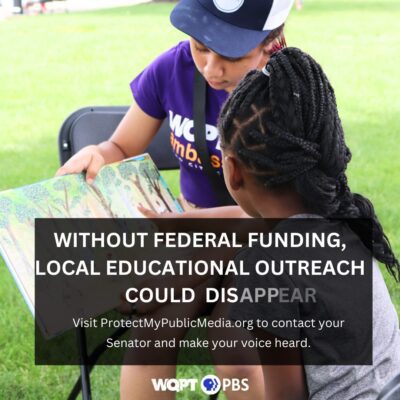
First Book Club is WQPT’s outreach program that provides five free books per year to at-risk-children by partnering with Title 1 classrooms. This literacy outreach ensures that children whose families cannot afford books, or might otherwise not have access to them, are provided the opportunity to build their own home library, Schmitt said. “First Book Club is vital to supporting education and diversity in the Quad Cities region.”
WQPT, a public media service of Western Illinois University, Moline, is not considering cutting the number of hours WQPT is on the air, which is 24 hours a day. “At this point I am just looking to cut the purchase of on-air programming,” Schmitt said. “We are humbled and very grateful for the increase in donations from our loyal viewers, local foundations and supporters.”
In response to the funding cuts, WQPT will not be increasing PBS programming. Only 25% of its programming is currently purchased from PBS, and Schmitt does not expect that to go up.
“The other 75% is locally produced or purchased from other public programming sources,” she said. “Our resources to purchase these productions will need to be carefully managed. We will continue to broadcast 24 hour per day with quality programming, but perhaps without some of the popular programs that we will not be able to afford the broadcast rights to.”
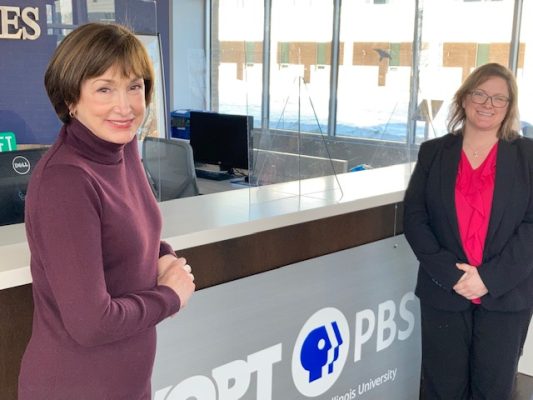
Lora Adams, left, and Dawn Schmitt at WQPT’s front desk.
At public radio station WVIK (90.3 FM and 98.3 FM in the QC), general manager Jared Johnson said Thursday that last year, the station got about $135,000 from CPB, accounting for about 13% of the station budget. This fluctuates year to year, but not much, he said.
“WVIK will immediately be making direct appeals to our listeners to help us fill in this gap,” Johnson said. “We will also be working with local businesses and foundations. Currently 85% of our funding comes from local sources. This year we’re going to have to make that 95%!”
“I don’t anticipate cuts in staff or programming immediately, but the fundraising done during these next six months will do a lot to decide what 2026 looks like for us,” Johnson said.

Jared Johnson is director of development and community engagement for WVIK.
WVIK (based at Augustana College, Rock Island) has definitely seen an uptick in support during its pledge drives this year, but CPB is the station’s largest single funder, the GM said. “So it will take a lot of $5-$10 a month donors to make that up. That being said, I know we’ve got thousands of listeners who don’t yet donate. So this is definitely possible.”
Protect My Public Media has been urging people to call their U.S. Representative now and urge them to protect local stations and vote against the Rescissions Act. After entering your information, click “Call Your Lawmaker.” A blue screen with talking points will appear. Scroll down and click the same button again to initiate the call. You will receive a call from 202-335-6941, which will connect your Representative’s office. If you have trouble connecting through the patch-through, you can look up your Representative’s number at Congress.gov, and call them directly.
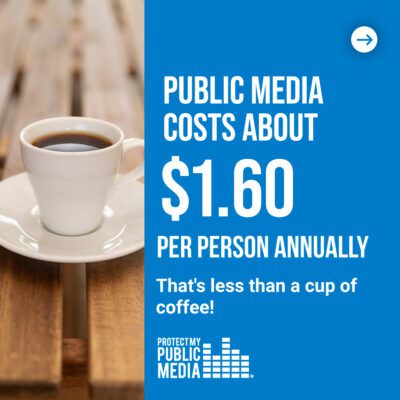
Clawing back this funding – about $1.60 per person per year – wouldn’t simply force stations to scale back. It would dismantle essential services: emergency alerts that save lives, local journalism that informs communities, and educational tools that support families, teachers, and job seekers, the group says.
On Thursday, Davenport musician and public media supporter Patrick Downing posted his letter (on Facebook) to Iowa U.S. Rep. Mariannette Miller-Meeks, urging her to oppose the funding cuts.
“If enacted, public radio and TV stations across the country will be forced to make deep service cuts – and rural, small, and Tribal stations could go off the air entirely. Tens of millions of Americans stand to lose access to essential services and local media altogether,” Downing wrote.
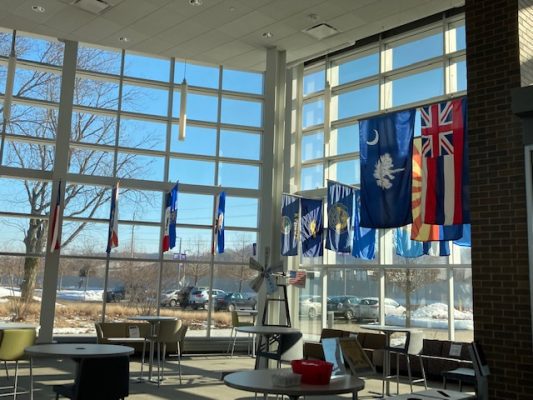
The airy, light-filled lobby in Western Illinois University’s Building C in Moline, where WQPT is based.
“I am a proud listener and supporter of Iowa Public Radio, WQPT PBS, WVIK, Quad Cities NPR, and Tri States Public Radio. Despite what Senator Ernst stated on the Senate floor, PBS and NPR are NOT political or ‘woke’ propaganda,” he said. “Along with the fact-based news programming and culturally enriching programs I enjoy viewing/listening, my children are avid fans of PBS Kids shows including Sesame Street, Super Why, Daniel Tiger, among others. These are educational programs that seek to not only entertain, but to teach and help develop our children to become better citizens for a kinder and more understanding society in the years ahead.”
Patricia Harrison, president/CEO of the Corporation for Public Broadcasting (CPB), issued the following statement today in response to U.S. Senate approval of the rescission package eliminating CPB funding:
“Today’s vote by the U.S. Senate to eliminate federal funding for the Corporation for Public Broadcasting is a decision with profound, lasting, negative consequences for every American.
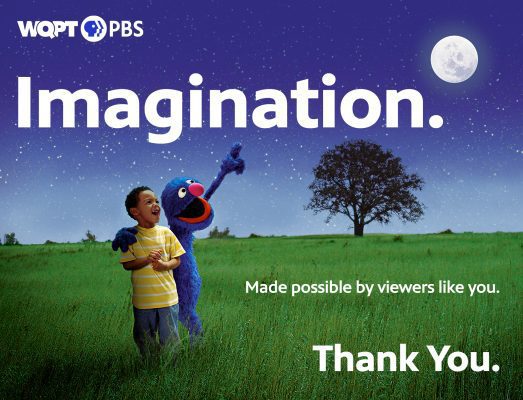
WQPT PBS helps inspire children everywhere and sparks their imagination.
“The American public trusts and values public media, whose exceptional content and essential services are a public good that strengthens local communities. For nearly six decades, public media has served families in every corner of America, especially rural and tribal communities, providing extraordinary vital content and services free of charge.
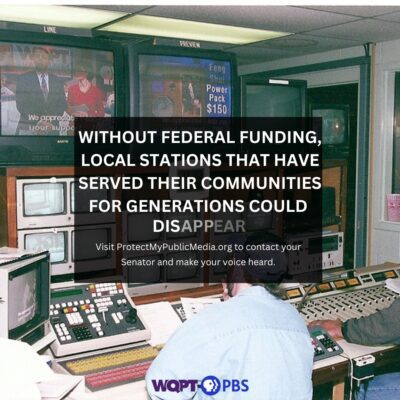
“Without federal funding, many local public radio and television stations will be forced to shut down. Parents will have fewer high quality learning resources available for their children. Millions of Americans will have less trustworthy information about their communities, states, country, and world with which to make decisions about the quality of their lives. Cutting federal funding could also put Americans at risk of losing national and local emergency alerts that serve as a lifeline to many Americans in times of severe need.
“American taxpayers rightly expect and deserve public media to be reflective of and responsive to the local voices it serves and deliver accurate, unbiased, and nonpartisan news and information. Rather than dismantle public media, we should fund and strengthen it. The path to a better, more trusted public media is only achievable with continued federal support and constructive reforms.”






Leave a Reply
You must be logged in to post a comment.