

Fresh Films Leading Effort for New $12M Film Studio in Rock Island
If you build it, will they come?
That famous catchphrase from the classic 1989 Iowa film “Field of Dreams” applies to the planned $12-million film production facility to be built on Rock Island’s 5th Avenue, between 20th and 22nd streets, called Rock Line Studios.
That project – including two soundstages totaling 35,000 square feet of production space – has raised $9 million so far (including a $3.8-million state of Illinois grant and up to $2 million in city TIF funding), and they won’t break ground until all funding is committed. Construction is estimated to take about a year, and is led by Rock Island-based Fresh Films.
Though over 20 feature films have been shot in the Quad Cities, in order to better attract film and TV production, the region has lacked a professional soundstage — the key piece of infrastructure needed to keep productions local, and Rock Line Studios was created to fill that gap.
The new studio will serve as a catalyst to diversify the local economy, not just in job creation for local talent but also in how it can attract professionals from the entertainment industry, spurring the growth of related businesses and services which adds to the overall financial health of the community, according to the grant application.
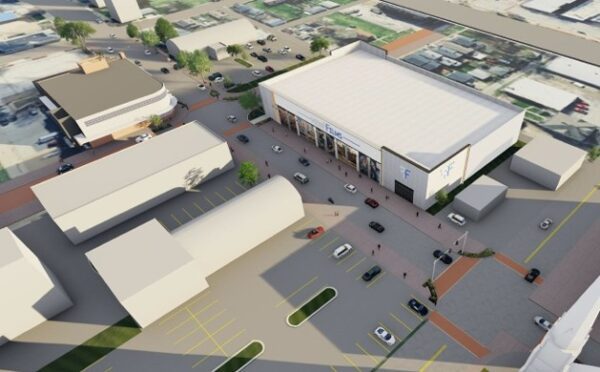
An aerial rendering of the planned new film production studio (right) with a related office/production support building (left), created by renovating a building to be acquired from MetroLINK. (Fresh Films)
Rock Line Studios is to be built just blocks from the Fresh Films offices at 428 19th St. The nonprofit Fresh Films is an Emmy-nominated film production and training organization, founded in 2002 with national reach and headquartered in the QC, that creates kids’ and family film and TV shows while training young people for jobs in film and growing digital content.
The Rock Island studio head is Davenport native Michael Wiebler, who has several years of experience working for Hollywood studios (including Sony and Universal), and spent the last six years in Los Angeles as the National Football League’s director of content strategy.
“I feel like we’re at the 10-yard-line about to go in for a touchdown,” Estlin Feigley, Fresh Films’ co-founder and chief creative officer, said recently. “We’re in the red zone. But we are still actively raising money. A lot of exciting stuff has come forward along the way, but we’re still so close. It’s like, gotta just get over the hump.”
“The Fresh Films angle is what makes it unique, that we can take traditional investment where investors are seeking returns and there are other people,” he said of being a nonprofit. “They can actually donate to the project in the same way that they would support any nonprofit.”
“We’re really focusing on the economic impacts for the community, knowing that the amount of jobs that this will create in both the build-out and also productions themselves,” he said. “But also, the productions that come in, they’re not just spending all their money on the studio, they’re spending it around the area for hotels, catering, transportation.”
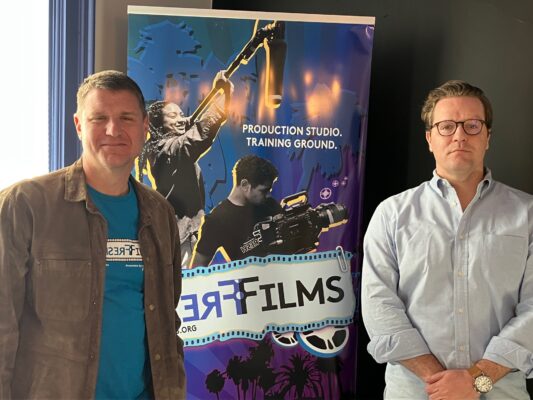
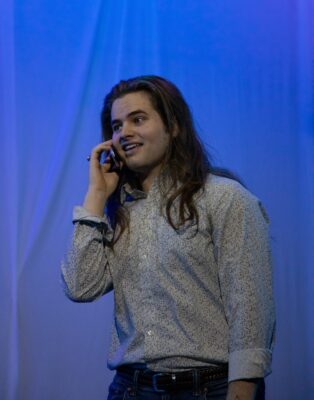
Estlin Feigley (left), Fresh Films co-founder and chief creative officer, and Michael Wiebler, head of the new Rock Island Studios, at the Fresh Films office in downtown Rock Island (photo by Jonathan Turner).
Feigley (a 1993 Augustana College alum), with his wife Kelli, has based Fresh Films in Rock Island since 2016, and wanted the new facility to be in Rock Island. It will be available for any productions (within or out of town), and for Fresh Films programs during down time.
“We really felt like Rock Island was a great place to be because it’s so many reasons,” he said. “Close proximity to some of the Broadway district places where they could shoot locations, quick access to the Arsenal…It’s just a good center point and has a lot of history. And I think also too, the cost of living here is just exponentially lower. I mean, it is 1/10, I think, what the national average is.”
Fresh Films plans to work with college students from not only Augie’s film program, but other area schools, Feigley said. Fresh Films shoots in 35 cities nationwide, including Atlanta, Boston, Louisiana, Minneapolis, Chicago, Pittsburgh, and Las Vegas. They typically work with 500 students a year, including 40 in the QC.
“All of those local folks could funnel in as production assistants” in the new studio, Feigley said, “or entry-level jobs that they need because the productions that come here, they’re going to bring in a lot of their top talent or department leads. But then they’re going to want to fill in all of those other support roles with local talent.”
The studio will make a big difference in attracting more filming to the QC.
“It’s going to be a world-class space,” Feigley said. “It allows a lot of the filmmakers from all over the country to give them that first break in to the industry. You know, that’s the most difficult part. Fresh Films is fantastic. They have the experience.”
“There’s other metro areas outside of Chicago and Illinois that could arguably compete at the same way that the Quad Cities does with airports, lower infrastructure costs in general across the board,” Wiebler said. “However, what’s missing here to really attract productions is having that soundstage space where they can actually build sets and have that complement of all the things that they like about the area. And in terms of natural locations, anywhere from historic to modern, rural, urban, this will allow them to complement that type of production experience that they seek elsewhere.”
He expects productions coming to Rock Island will have budgets in the $5 million to $30 million range.
Launched with $3.8-million state grant
Rock Island-based Fresh Films in early 2024 won a $3.8-million State of Illinois grant to expand film and television workforce development in the QC. During that process, it became clear the region lacked a professional soundstage — the key piece of infrastructure needed to keep productions local. Rock Line Studios was created to fill that gap.
The studio will serve as a catalyst to diversify the local economy, not just in job creation for local talent but also in how it can attract professionals from the entertainment industry, spurring the growth of related businesses and services which adds to the overall financial health of the community, according to the grant application.
“The grant is an investment in economic growth, cultural enrichment, and community development, with far-reaching benefits for the Western Illinois region and for the State of Illinois,” Fresh Films said. “We look at this as an opportunity for all boats to rise as we partner together to benefit the region and its Illinois residents.”

An architect’s rendering of the planned $12-million Rock Line Studios, to be built on Rock Island’s 5th Avenue between 20th and 22nd streets.
The QC already has many production-ready assets, including trained union crew, affordable infrastructure, and proximity to Chicago, according to the studios’ FAQ. “What it has been missing is a professional soundstage. Rock Island offers the right mix of cost efficiency, location, and community support to sustain a long-term production facility,” it says.
In addition to grant projects in Chicago and Champaign, the $3,797,000 grant for Rock Island will support construction of soundstages and related production support to attract and serve large-scale film and TV productions.
The Rock Line Studios campus will include:
- Two connected soundstages totaling approximately 35,000 square feet with 40-foot ceilings.
- Production offices, wardrobe space, mill/workshop areas, storage, ample parking and crew support.
- Room for future expansion as demand grows.
The facility is designed to meet real market demand rather than overbuild. Each production typically supports:
- 50-100+ crew jobs
- Spending at local hotels, restaurants, and service businesses
- Construction, fabrication, and trade work
State studies show film production generates strong local economic multipliers, particularly through wages and services.

Fresh Films (based in Rock Island since 2016) is an Emmy-nominated film production and training organization, founded in 2002 with national reach and headquartered in the QC, that creates kids and family film and TV shows while training young people for jobs in film and growing digital content.
Rock Line Studios is designed to work within Illinois’ broader production ecosystem. Recent expansions to the state’s film tax credits make projects outside the Chicago area especially attractive, including an additional 5% incentive for non-Chicago counties on top of Illinois’ nationally competitive base credit.
Those incentives allow productions to stay in Illinois while choosing locations like Rock Island that offer lower operating costs, available crew, and professional infrastructure. Rock Line Studios helps extend the reach of Illinois’ film economy beyond Chicago — keeping more productions, jobs, and spending in-state.
The state recently expanded its production tax credit package, as Illinois Gov. JB Pritzker in December 2025 signed the new incentives into law. The major program enhancements are:
- Illinois resident labor: New rate of 35% (up from 30%) on labor expenditures for Illinois residents.
- Illinois vendor spend: New rate of 35% (up from 30%) on spending with Illinois-based vendors.
- Non-resident positions: Up to 13 crew (from 9), 30% credit on the first $500,000 in wages each.
- Program sunset: December 31, 2038 (from 2033), offering long-term stability for production and budget planning.
Non-resident actors receive a 30% credit on the first $500,000 per actor, with limits based on production budget. And productions filmed in the Quad Cities can earn up to an additional 20% in stackable bonuses, potentially reaching a total credit of 55% on eligible expenditures:
- 15% tax credit bonus for salaries paid to Illinois residents from high-poverty or high-unemployment areas.
- 5% bonuses for labor expenditures of Illinois residents when filming outside Cook, DuPage, Kane, Lake, McHenry, and Will counties.
Boosting production outside Chicago
The Illinois Film Office and its director Peter Hawley have been early and strong champions of the QC facility, driving the state expansion of tax credits to help areas outside Chicago, Wiebler said recently.
“That 5% incremental increase was geared towards driving production to areas outside of Chicago. They don’t want Illinois to be perceived as just production in Chicago,” he said. “They want it to be the entire state and this is going to be an anchor to that.”
Film production expenditures in Illinois reached $653 million in 2024, the second-highest total in state history, generating an estimated $351 million in wages and 18,200 hires across the industry (excluding extras).
“We’re in the sweet spot to where the core cost basis comes down significantly from what they would pay in Chicago,” Wiebler said. “But at the same time, our proximity to Chicago means that we can still tap into them for resources. So, for example, if productions will probably get all of their crew equipment from major equipment houses in Chicago, and that’s easy for them to get that shipped and delivered as needed.”
“But if you want rural, if you want Mississippi River, if you want an Army base, I mean, there’s a lot to offer here,” Feigley said. “A continuous stretch of old homes, I mean, my goodness, you go up the Broadway district and shoot from 1910 all the way up to today.”
Rock Line Studios plans to break ground when all outside funding for the project is committed, Wiebler said. It also helps that the soundstages will be brand-new construction, not renovation of an existing building.
“Frankly, that’s what makes this facility unique to the industry because it is being purpose-built with current productions in mind,” Wiebler said. “We’ve gotten advisement from folks all across the industry and all levels of production to say this is what we’re thinking. What do you think? What should we do?”

An architect’s rendering of the new Rock Island film production facility.
“How does that actually fit into the types of productions we’re going to attract. But it is a purpose built, filmmaker-informed construction,” he said.
The project has attracted a lot of private local funding, and public support from the city of Rock Island. Last August, the City Council approved a development agreement with Fresh Films to reimburse up to $2 million of TIF-eligible expenses to be paid from project increment for a period of up to 10 years. Fresh Films was the sole respondent to a request for proposals to purchase city-owned property at 2016 5th Avenue and 2001 5th Avenue, for a total of $134,500.
At the April 14, 2025 City Council meeting, the Rock Island City Council approved a letter of intent to sell the two properties to Fresh Films for the development of this project. The development agreement will be paid from increased property tax revenue within the Downtown TIF.
Fresh Films also hopes to use the new studio space to train young filmmakers and shoot projects.
“When there isn’t productions there, it gives us a state-of-the-art facility where we can actually train filmmakers in production when we are running our real productions that we’re doing,” Feigley said. “It would have been really nice to be able to build a set out in the studio this summer when we were doing our ‘Groundhog Gary’ movie, which was pretty exciting. We had a puppet that was on the set, so it would have been nice to be able to make it so the public could walk around underneath the set and shoot it a little bit differently. We shot that on location, which was fun. It was an exciting challenge, but it sure would have been nice to have a studio space to build.”
Growing the creative economy
Scott Beck, Bryan Woods and Julia Glausi (filmmakers and owners of Davenport’s Last Picture House), have said of the studio project:
“As filmmakers and producers who are native to the Quad Cities, we know exactly what’s been missing from the local production ecosystem. This soundstage is that missing piece — a purpose-built, production-ready facility designed for how projects are made today. It creates the infrastructure, credibility, and continuity needed to attract major productions while empowering local creators to stay and scale. With a dozen projects currently in various stages of development and production, we look forward to having the ability to bring projects to the area.”
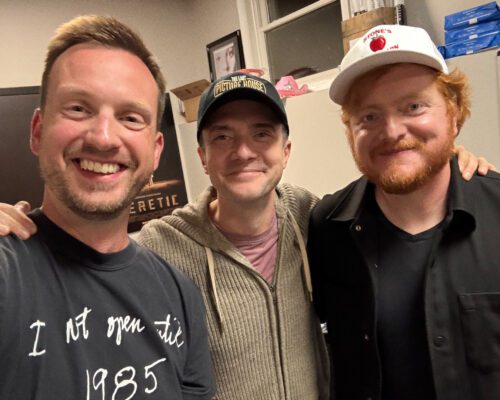
Filmmakers Scott Beck (left) and Bryan Woods (right), with actor Topher Grace, who came to their downtown Davenport movie theater, Last Picture House, for a film screening and Q & A in fall 2025.
Fresh Films estimates for every $1 tax credit per project, the QC economic value is $6.81. That translates, for example, a $10-million production, with 100+ person crew, would get a $4-million tax credit, with a $27,240,000 local economic value (71% wages/services, 29% induced impacts).
“There’s always going to be an element of competition for this, but at the same time, we think that holistically, when this facility is complete, what the Quad Cities has to offer can compete with anyone,” Wiebler added. “Between the world-class facilities, existing crew, lower cost basis, the incremental tax benefits. When you put all of that together, it’s a pretty compelling package.”
For more information on Fresh Films, click HERE.









Leave a Reply
You must be logged in to post a comment.