

Figge in Davenport to Host Ballet and Chamber Music Programs for Violins of Hope
As part of the inspiring, educational “Violins of Hope” partnership in the Quad Cities, the Figge Art Museum, 225 W. 2nd St., Davenport, is hosting two upcoming programs in the series.
On Thursday night, April 16, at 6 p.m., dancers from Ballet Quad Cities will perform four original pieces, including “Quack, Quack, Quack”—a reenactment of Anne Frank’s response to her math teacher’s admonishment for talking too much.
The choreography for “Infinity” was inspired by a local 6th grader’s artwork titled “Infinity Tears.” In artist Eve Wilbur’s words, “When we choose to reflect and remember our past, including the pain and sorrow, only then will we see meaningful change.”
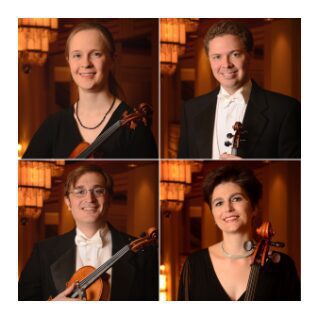
The QC Symphony quartet to perform Saturday, April 18 at the Figge lobby includes violinists Hillary Kingsley and Erik Rohde, violist Nick Munagian, and cellist Hannah Holman.
In “Kaddish,” two dancers portray art prints by Mauricio Lasansky, the founder of University of Iowa’s printmaking program. Inspired by the Jewish mourner’s prayer, Lasansky’s “Kaddish” print series captures the grief, hope, and peace embedded in the experiences of Holocaust victims and survivors.
Dancers also celebrate the invention of the radio, which revolutionized communication by providing instant access to news and entertainment, but was also used for Nazi propaganda. The dances are set to music by composers who died in camps during the Holocaust. Original choreography by Courtney Lyon and Emily Kate Long, BQC artistic director and artistic associate, respectively.
This free program is in partnership with the Jewish Federation of the Quad Cities, Violins of Hope, and Ballet Quad Cities School of Dance. Thursday at the Figge will start at 5 p.m., with a cash bar and food available for sale. The BQC performance will begin at 6 p.m.
The Figge lobby will again host a “Violins of Hope” event Saturday, April 18, at 7:30 p.m., with a Quad City Symphony “Up Close” chamber concert, featuring Hillary Kingsley and Erik Rohde on violin, Nick Munagian on viola, and Hannah Holman on cello.
The program is comprised of:
- Wolfgang Amadeus Mozart’s Symphony No. 25, first movement arranged for quartet.
- Ludwig van Beethoven’s Symphony No. 7, second movement arranged for quartet.
- Samuel Barber’s Adagio from String Quartet Op. 11.
- Franz Schubert’s “Erlkönig” arranged for quartet.
- Steve Reich’s “Different Trains” for string quartet and tape.
Reich’s 1988 work (27 minutes long) includes pre-recorded performance tape. In program notes, the composer wrote –
“The idea for the piece came from my childhood. When I was one year old my parents separated. My singer, songwriter mother moved to Los Angeles and my attorney father stayed in New York. Since they arranged divided custody, I travelled back and forth by train frequently between New York and Los Angeles from 1939 to 1942 accompanied by my governess. While the trips were exciting and romantic at the time I now look back and think that, if I had been in Europe during this period, as a Jew I would have had to ride very different trains.
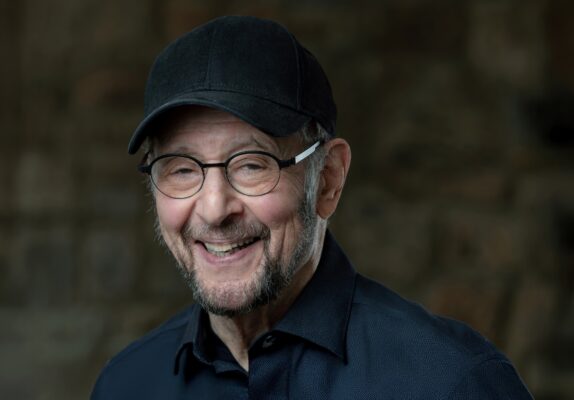
Composer Steve Reich wrote “Different Trains” in 1988.
“With this in mind I wanted to make a piece that would accurately reflect the whole situation,” Reich wrote. “In order to prepare the tape I did the following:
- Record my governess Virginia, then in her seventies, reminiscing about our train trips together.
- Record a retired Pullman porter, Lawrence Davis, then in his eighties, who used to ride lines between New York and Los Angeles, reminiscing about his life.
- Collect recordings of Holocaust survivors Rachella, Paul and Rachel, all about my age and then living in America—speaking of their experiences.
- Collect recorded American and European train sounds of the ‘30s and ‘40s.
“In order to combine the taped speech with the string instruments, I selected small speech samples that are more or less clearly pitched and then notated them as accurately as possible in musical notation,” he said.
“The strings then literally imitate that speech melody. The speech samples as well as the train sounds were transferred to tape with the use of sampling keyboards and a computer. Three separate string quartets are also added to the pre-recorded tape and the final live quartet part is added in performance.”
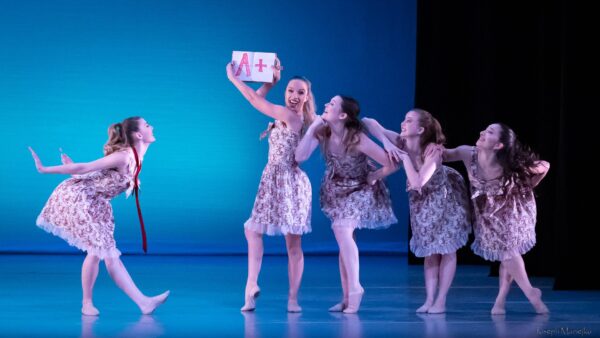
A previous company of Ballet Quad Cities performing “Quack, Quack, Quack,” inspired by an Anne Frank story.
“The piece thus presents both a documentary and a musical reality and begins a new musical direction,” Reich wrote in 1988.
Violins of Hope (which includes 67 instruments displayed in the Quad Cities over the past two months) is a collection of string instruments connected to Jewish musicians and the Holocaust. Many of these instruments were played during the Holocaust, including in ghettos and camps, under unimaginable conditions. Today, they are carefully restored and returned to the stage to share stories of memory, resilience and hope.
You can see a “Beyond the Music” conversation about Saturday’s program with QCSO violinist Hillary Kingsley and QCSO executive director Brian Baxter HERE.
Tickets for “Up Close” are available on the QCSO website HERE.
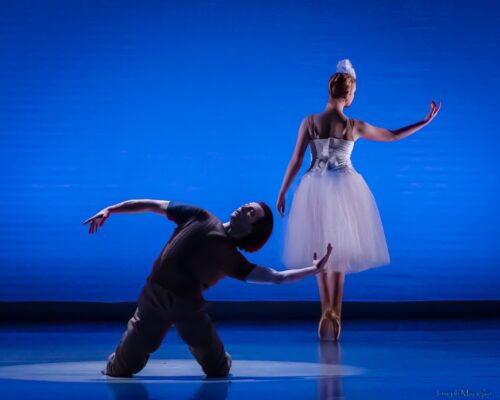
Ballet Quad Cities will perform four short pieces at 6 p.m. Thursday, April 16 at the Figge Art Museum with music by Jewish composers who died in Holocaust concentration camps.





Leave a Reply
You must be logged in to post a comment.