

Another Day, Another World Premiere for Prolific Quad-Cities Playwright
February has been kind of a busy month for Alex Richardson.
The prolific playwright is back with his Barely There Theatre to present another world premiere (his second in less than a month) at the Black Box Theatre in downtown Moline. “word play” is a new play from Richardson, and first-time director Emma Wahlmann, featuring a brand-new style of lighting design and 80 minutes of original music, also written by Richardson.
Opening Thursday, Feb. 19 (running through Feb. 28), this play is just in time to be late for Valentine’s Day, with a “falling out of love” story. It comes quickly on the heels (to fit in a down month in the BBT schedule) of Richardson’s recent “What Might Have Been,” an intermission-less collection of three original one-acts, performed Jan. 29-Feb. 7.
“How often do I get to do two back-to-back shows? And so, yeah, it was just scheduling,” Richardson said recently.
In “word play,” there are four characters, played by Shyan DeVoss, Keenen Wilson, Sera Calhoun, and Evan Gagliardo. “Zero directions. A world detached. Experience a raw, unscripted exploration of the moment love becomes a memory, where the only thing written is the dialogue, and the rest is a once-in-a-lifetime collision of souls,” according to Richardson’s synopsis.
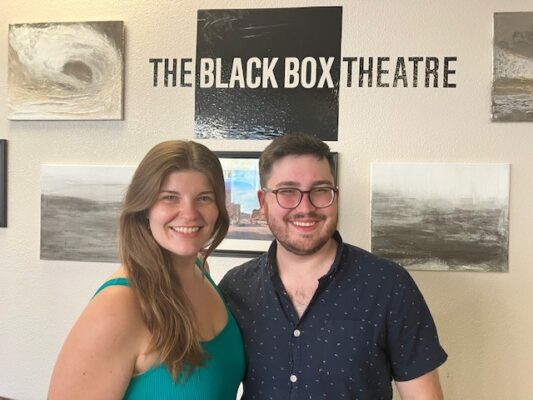
Alexander Richardson and his wife Sydney at Black Box Theatre, Moline. (Photo by Jonathan Turner).
Barely There started during the pandemic, as recorded informal readings of Richardson’s own plays and works in the public domain (like Shakespeare and Chekov, he said).
The last two weeks of “What Might Have Been” overlapped with the first two weeks of “word play” rehearsals. “And so there were days where they’d be rehearsing a show on stage, and we would be rehearsing in the back in the prop room with space heaters, because the heat was out at that point in time,” Richardson said Wednesday.
Emma Wahlmann (a 2024 Western Illinois University grad) was stage manager for Black Box shows “To Kill a Mockingbird,” “The Truth” and “Fun Home.” Richardson worked with her on The Speakeasy’s “Rocky Horror” show last October, and shared his “word play” script, asking if she could direct (which she’d never done).
“And I wasn’t going to say yes because I was scared. But then I read it, and then Alex pitched me his concept, and here we are,” Wahlmann said. “And I don’t regret it. I don’t regret it in the slightest.”
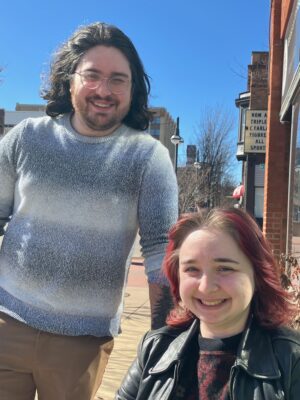
Playwright Alex Richardson and director Emma Wahlmann in downtown Moline, Feb. 18, 2026 (photo by Jonathan Turner).
She took a directing class in college, “and I absolutely hated it. But I had a change of heart, so here we are,” she added Wednesday.
Stage managing is in charge of a show’s scheduling and technical aspects, “making sure that the production runs smoothly, just making sure you get everyone on track and staying on track and keeping track of props and costumes and blocking,” Wahlmann said. “Basically being a hub of communication. So directing has been a bit of a departure from that. It has some overlap, but definitely a slightly different circle.”
Typically a stage manager also operates lights and sound during performances, but Richardson has taken on those roles for many BBT shows, without being the stage manager.
“I’m not as organized as one needs to be to be a stage manager. So it’s rare that I’m on this side of things,” he said. Here, though, Richardson’s roles are producer, playwright, stage manager, composer, and designer.
Resurrecting his first play
Richardson first wrote “word play” (his first play) in 2015, when he was 21, at University of Illinois-Champaign (a communications major with a minor in English).
“I was in a show where it was a cast of like 20 some people and for the first act, everyone else was on stage but me. It was a long show, so it was an hour and a half of me totally alone in the back of the theater,” he recalled. “I just got bored one night and so I just started writing something. And started off as this one scene. I was like, okay, that’s good.
“And then we staged it later that year for a charity show. I was like, man, I really like those characters,” Richardson said. “I wonder what their story is. And so I wrote another scene. Another scene. And then accidentally, over the course of a few months, I had written a full-length play.”
He’s had readings of it over the years, and has revised it several times, but never fully staged until now.
“Then finally I was like, I think Emma might be the right director for it,” Richardson said. “And then when we started talking about who Emma wanted to work with, I was like, I think this is the right team to finally, after more than a decade, bring this thing to life and let it see the light of day…It’s been a lot of work. But I’m “really happy with the draft we’re running now.”
Unlike most scripts, “word play” has no character names or stage directions.
“They just have a letter to know who’s supposed to say what when. And then there will be chunks of the page where there’s nothing,” Richardson said. “They’ll have like their letter to say something is supposed to happen. And then it’ll be like a third of a page where there’s just empty space. And so it’s been on Emma and the actors to figure out what is that empty space and how do we bridge what was just said to what is said later down on the page?”
“It’s been really freeing, but also a little bit tricky,” Wahlmann said. “There have been times where I’ve been like Alex, any intentions that you meant here? It’s been so lovely having Alex in the room. We can know exactly where we’re heading.”
Love triangle over a love trapezoid
The four characters are in various stages of relationships with each other. “They all live in a big city and we see them. It’s a non-linear timeline,” the director said. “So we see each scene kind of episodically instead of in one fluid timeline.”
“It’s like a love triangle stacked on top of a love triangle with like a love trapezoid in the middle,” Richardson said. “It’s not a love story, it’s a falling out of love story.”
“It’s kind of how the way our memory works where we’ll think we’ll see something or we’ll hear something and it’ll call us back to a different time in our life years ago,” he said. “And the way how a phrase can take us somewhere else entirely. And so while we’ll start with one scene and the next scene is 10 years in the past, the way it flows from one into the next is just this phrase, oh yeah, we said that 10 years ago. And then suddenly we’re somewhere else. And so it flows emotionally, not chronologically.”
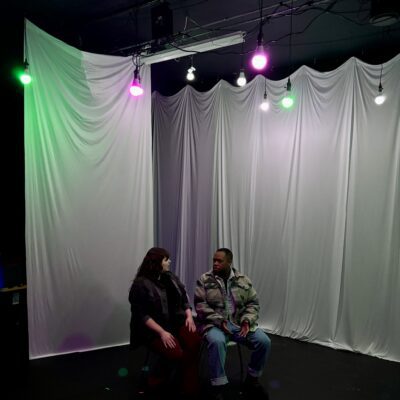
A scene from Alex Richardson’s “word play,” running at Black Box Theatre (1623 5th Ave., Moline) through Feb. 28.
When Wahlmann blocked the show, she first worked with the actors in the story’s chronological order, not the order the audience will see them.
“And then after everything was blocked, we put them in show order so the actors got to feel the emotional shift that their characters go through and understand where they were,” she said. “Because since the scenes are out of order in terms of the chronological timeline, then they would know where they were emotionally and the shifts they would have to make from oh, I love you to oh, we’re breaking up in the next scene. And just the split second of exiting stage and then re-entering and jumping into that completely different emotional beat.”
Richardson did it this way since he felt this was the most interesting way to tell the story.
“To show us a scene, to show the audience a scene, and then say, okay, why are we here? And then jumping to the why, and then having that scene happen and be like, well, how did we get there?” he said. “It’s kind of like unpacking the how did we start? And working our way backwards from there to the very beginning of the end.”
Richardson doesn’t have actors improvise lines.
“It’s the moments between the lines that they are kind of making different choices each night,” he said. “And also then the lines themselves, how they’re saying it. Like, as a really easy example, there’s a line where some nights, one of the actors delivers it really happy, and then other nights, she just is gonna do it angry tonight. And it’s fun to watch how that choice, then the actor responds, and it builds the rest of the scene from there.”
Wahlmann is having a reunion with one of her theater friends from Rock Island High School, Sera Calhoun, in the cast. Emma graduated in 2020, and Sera in 2019 (her sister Kat has worked as a Circa ’21 Bootlegger).
“So this is a really good, cool, full-circle moment of getting them up on stage as the actor,” Wahlmann said of Sera. “I knew that Sera had been wanting to come back to acting after not doing it for, I think, seven years. So Sera was actually the first person that I knew that I wanted in the show because I read the script and one of the characters name is S. And I was like, well, Sera’s name starts with S. And this definitely feels like someone Sera would play.”
New, unique light and sound system
Richardson also created a light and sound system that’s new and unique to the area (his regular job is as a software engineer for the Air Force).
“I’ve never seen anything like it anywhere else,” he said. “I’ve maybe seen something like it at art exhibits or like museums or like installations, but I’ve never seen it utilized for theater. And so what it is, I use my day job in software development, and I built a program to run the lights for the show. And before I even get there, I wrote music for the show. And the music plays throughout the entire show.
“And there’s moments in the music where, like, a note will chime because every character has their own instrument connected to what that character is,” Richardson explain. “One of the lights will chime the color for the character. And then every single night, the way it chimes is different. It responds to the actors on stage. And it’s a very dynamic lighting and sound system. Because that was something I’ve always wanted to see more of in theater is the actors, every night they go on stage, they can make new choices. They can be different.”

Playwright Alex Richardson has written over 10 plays in the past decade.
So each performance of “word play” will be slightly different.
“It’s more for the actors to never get — I don’t say comfortable, but to never know what to expect next,” he said. “Because there’s always this element of change that is also powering and fueling their performance. And what’s been really cool, as we’ve added in this system over the last week, is seeing how the actors respond to the music and the lights.”
“Night to night, it changes. It changes their performances too,” Richardson said. “And it’s like this really fun feedback loop of we have no idea what’s gonna happen night to night.”
The music is pre-programmed, and there are sound effects as well, he noted.
While Richardson hasn’t really written music before, he has collaborated several years with Circa Bootlegger and songwriter Micah Bernas.
“I would have a really specific idea of what a song sounded like. And I would work with him to get that song to life. Because he’s a songwriter, composer, he knows all that,” he said.
An ongoing soundscape
The new play has an “ongoing soundscape where we have several different layers of music in every scene,” Richardson said, noting that includes things like traffic, birds chirping and leaves rustling. “Then we have our main character, who always feels like he’s second fiddle to everyone around him. So his music is a violin playing. And then he has these counterpoints in his life where one character is an acoustic guitar and another character is an electric guitar to kind of provide the balance there. And then the fourth character has a saxophone for all his notes. As these different instruments play around one another. It just creates such fun textures and tones throughout the evening.”
Wahlmann said the sounds add a lot to the play.
“As stage manager in previous productions, I often get a little bit nervous when we do finally add in lights and sounds, because I know that act have a tendency to get thrown off when we’re first adding those elements,” she said. “But with jumping in to having full soundscapes for each scene and then the lights changing, our actors really just took to it like fish to water. It was really beautiful.
“I think I was thrown off more by adding in those elements than the actors were. So it’s really cool because they truly just layer their performances in with it and they use it to their advantage,” Wahlmann said.

The five-year-old Black Box Theatre is at 1623 5th Ave., Moline.
“With the lights changing, it’s almost like spa,” she said. “It’s mesmerizing.”
“Finding the balance has been challenging, but it’s been cool to where if I speed up, they’ll speed up, and if they slow down, I’ll slow down,” Richardson said of light and sound cues. “It feels like in some ways, I’m part of the performance, which I’ve never experienced before as a tech person, because usually you just, you know, you hit go. You kick your feet back until the next cue. But I have to be focused on what they’re doing and to know, all right, time to hit it again.”
Over his career, Richardson has written a total of 32 plays (including “To Leer at Lear,” “Their Town,” “Your Better Self,” and “Enemy of the People”), five screenplays, and been part of over 150 theater productions. “Which is an insane number to say and to know. I feel like I have a problem,” he joked.
In his next chapter, he said he’d like to get one of his plays performed outside the area.
“I always like that I’m trying something new. Like, my pieces don’t ever really feel too similar,” Richardson said, noting after his “All American Riot” in 2024, he was contacted by someone who runs a nonprofit Shakespeare company in western Virginia, interested in doing the piece.
“And it was just a little too rated R for his clientele,” he said. “It’s been really cool to kind of see people come to me and be like, hey, I think this might work for us, and talking with them. And so hopefully one of these days, I’ll be able to make that connection and get something out there.”
Performances of “word play” will be 7:30 p.m. Feb. 19-21, and Feb. 26-28, plus a 2 p.m. matinee on Saturday, Feb. 28 at the Black Box, 1623 5th Ave., Moline. The runtime is about 85 minutes with no intermission. Please note: Contains strong language. Since the company believes theater should be accessible to everyone, they use a “Pay What It’s Worth” model. Admission is free at the door, and you choose what to contribute at the end of the night based on your experience.
You can reserve your tickets HERE.










Leave a Reply
You must be logged in to post a comment.