

Bettendorf English Professor to Attend Climate Conference in Brazil
Environmental threats to the Amazon Rainforest will be front-and-center at the latest round of climate change negotiations known as COP30 in Brazil this month, and a Bettendorf man will be among the thousands of delegates there.
Everett Hamner, a Western Illinois University English professor, will be among the tens of thousands of delegates from 195 countries gathered in Belém, Brazil to advocate for the planet during a year that continues to face record-breaking global temperatures. Hamner’s official status as an Observer will allow him to engage with negotiators and report back to his community as he mobilizes for climate action in a politically polarized U.S., which is not sending any official government representative.
As a COP30 observer, Hamner will represent multiple Christian universities, NGOs, and ministries as part of the Christian Climate Observers Program (CCOP). The CCOP equips emerging climate leaders from underrepresented communities to engage in climate action at the COP Climate Summits. COP30 in Belém marks the sixth official year of the program.
The first CCOP program was in 2019 at COP25 in Madrid, and then at each subsequent COP. They bring two teams, one for each of the two weeks of the COP, with 20-24 on each team, and Hamner will be in Brazil from Nov. 14 to Nov. 23.
The climate conference COP30 will gather tens of thousands of delegates from 195 countries in Belem, Brazil from Nov. 10 to 24, 2025.
“Observer is an official United Nations role,” CCOP co-director Lowell Bliss said recently. “While there is some opportunity for input into the negotiations between governments, observers do their most important work when they report back to their home communities. Observers at a COP are surrounded by stories from 195 different countries, many of them on the devastated frontlines of climate change.”
COP30 will take place in Belém, Brazil Nov. 10-24, 2025. The CCOP2025 team will focus on three key topics expected to dominate the negotiations at COP30:
- More ambitious Nationally Determined Contributions (NDCs) — carbon emission reduction targets that seek to keep global warming below the Paris Agreement target of 2.0° Celsius.
- Climate Finance — assistance from developed countries to assist in mitigation and adaptation to climate change in developing countries.
- Challenges to the Amazon rainforest and its inhabitants — including the threats posed by mining and agri-business (not just by fossil fuel pollution), as well as threats to “Defenders” like the 148 indigenous and environmental activists who were murdered or missing last year according to a recent report by Global Witness, an international watchdog agency.
“You know how everyone wants nice parks and clean water, but nobody gets excited about City Council meetings? I’m going to the largest City Council meeting on Earth, COP30, because we can only take care of our planetary life support system by building trust across the world,” Hamner said recently.
The Paris Climate Agreement was adopted at COP21 in 2015, and Hamner says, “A decade ago in Paris, humanity decided to take big new steps to protect not just people closest to us, but those far away and even in our future. The devil is in the details, though, and this year I’m looking for a serious new global agreement to reverse deforestation and steward land more sustainably.”
Q & A With Hamner
Everett Hamner recently answered questions by e-mail about his involvement in the climate change conference. His answers have been edited and condensed:
- How did you get involved in CCOP?
I taught a course this summer at one of my alma maters, Regent College (Vancouver), on “Climate Theology and Storytelling.” Many of us think of American Christianity as rejecting responsible climate action, and there’s an enormous, lamentable pattern there. However, it’s not the whole story in the U.S., nor for Christianity worldwide. My course drew graduate students from nearly every continent, and through a connection with A Rocha Canada, a Christian environmental nonprofit, it led me to a conversation with CCOP’s leaders.
- Why is this issue important to you?
I’m working to tell this story and help people recognize their places in it because everything we value depends on getting it right, or at least a little more right. It probably won’t be an utter doom or a total success thing. This is going to remain a challenge throughout our lifetimes, and I want to contribute what I can. My relative strengths are in interpreting science and politics and in reaching across cultural differences, so that’s where I focus.
- What is your role in Brazil?
I will be there to learn more about where our current greatest climate adaptation and mitigation opportunities lie and to better grasp some of the negotiation and policy details that might bore others — people that wouldn’t want to sit through this kind of global City Council meeting. I’m also there to build more international relationships, especially since our proud country is not just stepping back from global leadership, but being perceived as a major barrier to other peoples’ well-being.
Lastly, I’m there to teach and mentor and inspire — both the many younger adults I’ll be living alongside and the people back home in my various communities for whom I can serve as a bridge to Belém. The United Nations Framework Convention on Climate Change is a mouthful, and every year we see diplomats around the globe talking at these events, but they can feel very abstract and distant.
Indeed, they risk amounting to what Greta Thunberg calls a lot of “blah, blah, blah.” But I want to help people connect to the parts of this effort that are being pursued in good faith, because this is our best international context available right now.
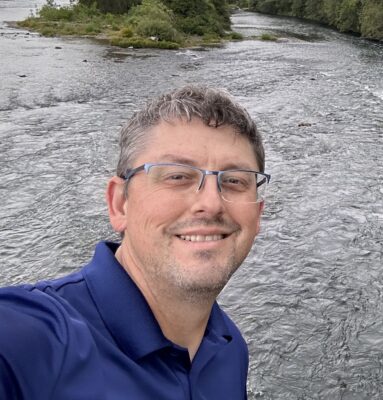
Everett Hamner of Bettendorf, a Western Illinois University professor of English, will attend the UN climate conference in Brazil from Nov. 14 to 23.
- What other climate change conference/events have you been part of?
Like many people, I’ve attended Earth Day-related events for years. Like many protest marches and political events, they can help you realize you’re not alone. In the U.S., though, we tend to massively underestimate how many people (on both sides of the political aisle!) really would prefer cleaner energy to dirtier, clearly unhealthy sources, and that’s because enormously wealthy fossil fuel corporations flood our media with disinformation and performances of their own “greenness,” when cleaner investments represent 0.5% of their budget and 99.5% goes toward exploiting old fuels.
In short, they want to milk their oil fields a little longer, no matter how much the emissions clog our atmosphere and hold in more heat.
Most of my conferences around climate issues have been in academic settings, where I’ve sought to learn from and inform fellow scholar-teachers about the many ways our systems really can change. This is doable, but my personal greatest area of investment is in getting the stories more visible that use every form of media — including novels, movies, TV, comics, and video games — to call attention to the problems and the solutions.
Whether it’s an international Association for the Study of Literature and Environment meeting or the local Upper Mississippi River Conference (which I’ve helped organize the last few years), I want to help people encounter new stories that both expose bad-faith sabotage and inspire newly sustainable and healthy ways of being.
- How would you describe the Trump administration stance on climate versus Biden’s and how does that influence COP30?
The difference is both very stark and smaller than one might expect. It’s no secret that President Trump believes climate action is bad for business, so he says the whole global problem is a hoax, one apparently perpetuated by 99.9% of the world’s scientists for several decades, which would be quite a sordid achievement! But while the threats are truly awful, the good news is that cleaner energy is not just the ecological or moral best bet, but now the economic best bet too.
To illustrate how far many Democratic leaders like Biden also still have to go, though, take a look at China for a moment. While many in our country fear China and don’t want to become like China for valid reasons — I recommend the documentary American Factory for better grasping the realities here — we should realize that they are eating our lunch when it comes to twenty-first-century energy development.
A few weeks ago, they opened a new solar farm that is larger than Manhattan, and that’s just one in a series. Their EVs are not only more efficient and more luxurious than anything on the U.S. market, but also way cheaper. Their high-speed trains are the envy of visiting Americans. That doesn’t mean ignoring their problems, or the fact that they are now the world’s annual largest greenhouse gas emitter, but it does mean realizing that they’re accelerating rapidly in the opposite direction, and the world is largely following them and leaving U.S. energy policy in the dust.
And this is where my critique of the Biden administration lies: while the Inflation Reduction Act brought a lot of much-needed new infrastructure investment, it was far smaller than originally planned, and it obscured the fact that even our Democratic-led administrations have been more dedicated to business as usual than our well-being can afford.
In other words, you don’t have to let go of your pride in being American to recognize the lack of courage and integrity from most Democrats here, before we even talk about the recent horror of today’s GOP leadership bullying other countries that were trying to reduce shipping pollution.
Whether you lean left or right, the truly patriotic thing is to say, “We can do a lot better, and the United States will be stronger if we celebrate both our independence and our interdependence.” Our life support system doesn’t have separate national compartments; our choices either improve or worsen things for everyone.
- Will the U.S. ever sign back on the Paris climate accords, is that a goal?
It’s entirely possible, but not my focal point right now. The real problem for the whole world at COP30, not just the U.S., is that the world’s 195 nations (197 if you count UN observer-states Vatican City and Palestine) nearly all SAY they’re part of the Paris agreement, but few have even begun to commit the scale of financial resources and emissions self-discipline necessary to put a truly livable boundary on our projected global temperature increase.
This is crucial because 1.5 or 2 degrees Celsius warmer sounds like very little to us, but what we need to realize is that when Chicago was four degrees colder — like 80,000 years ago — it was also under a mile of ice.
These average temperature changes mean a lot more risk to past norms than they seem to, and they upset the system so much that “global weirding” is a better term than “global warming.” When we get polar vortexes in the Midwest this winter, that will be because of the same problem: as the kids say, f with the atmosphere and you find out.
So I’m less concerned with participation ribbons and more with Paris’s substance: are people actually reworking their economies for this new century, realizing that we’re remaking what Christians call “Creation” in major ways, and that good human stewardship means smarter, larger-scale changes?
Sure, symbolism matters; for instance, it matters to my credibility that I’ve chosen to eat mostly vegetarian, with some seafood, and that I generally limit unnecessary consumerism — but there are even bigger things to consider. Few people realize that it was fossil fuel companies that came up with the whole “carbon footprint calculator” idea, because they benefit if we mainly think about all this as individuals.
What we really need, though, is to link arms across our differences and rethink our bigger systems. This can be a really enjoyable, healthy, life-giving process. We need to talk about it more first, then we need to do it. It can’t be about green self-righteousness or partisan politics if it’s going to shift quickly and broadly enough.
Hamner (who has taught English at WIU since 2008) will be connecting with a panel and audience at Western Illinois University from Brazil via Zoom on Tuesday Nov. 18 at 4:15 p.m. Central. You can email him at e-hamner@wiu.edu for a private Zoom link.
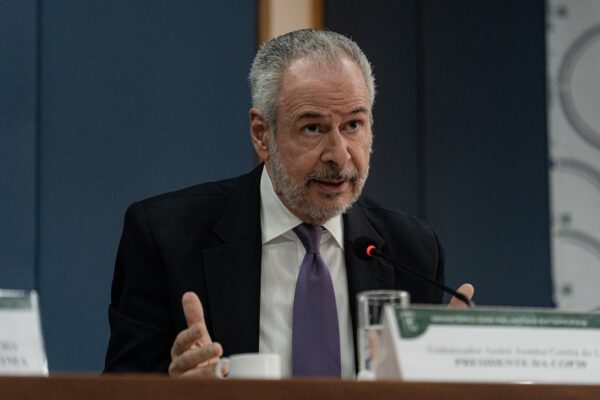
Ambassador André Corrêa do Lago, COP30 President-Designate.







Leave a Reply
You must be logged in to post a comment.