

Steve Martin’s “Picasso at the Lapin Agile” returns to Geneseo this weekend
For the first time since 2002, Geneseo’s Richmond Hill Players will present Steve Martin’s absurdist comedy, “Picasso at the Lapin Agile,” Thursdays through Sundays, August 20-30 at the Barn Theatre in Geneseo.
Directed by RHP veteran Jennifer Kingry of Geneseo, in the play you can step into Paris, 1904, for a legendary battle of wits.
Actor/screenwriter/comedian Steve Martin’s intellectual comedy Picasso at the Lapin Agile (which premiered in 1993) imagines a fictional encounter between young Albert Einstein and young Pablo Picasso at a bohemian café, as both stand on the verge of cultural breakthroughs: Einstein’s special theory of relativity and Picasso’s cubism. The two debate art, science, and inspiration alongside a colorful cast of eccentric bar regulars, culminating in a surreal visit from a time-traveling rock’n’roll icon. Blending philosophical ideas with laugh-out-loud physical comedy, the play explores the creative spark that defined the dawn of the 20th century and offers a thought-provoking and entertaining night of theater, according to a synopsis.
The play is rated PG-13 for adult humor, mild profanity and barroom setting. As a one-act play that runs under 90 minutes, it will be performed without intermission.
Its first professional production was at Steppenwolf Theatre in Chicago in late 1993. One year later, in October 1994, it played at the Geffen Theatre in Westwood (Los Angeles). In 1993, Kingry said she was living and working in Los Angeles (she even saw Martin at an L.A. restaurant in 1983).
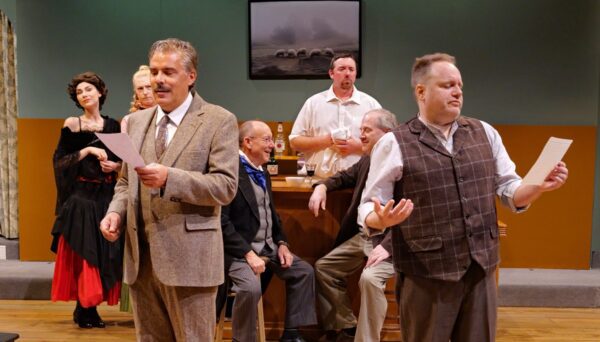
(from left) Kassidy Holdridge, Tori House, Mischa Hooker, Andy Schaser, Matthew McConville, Bruce Carmen, and Justin Raver in the new Richmond Hill production of a Steve Martin play, opening Thursday, Aug. 20.
After moving back to Illinois, she first read “Lapin Agile” in the late ‘90s and “I can still recall the excitement I felt simply reading it,” she said this week by email. “It just hits so many of the buttons that I enjoy most about doing theater. It’s a play of ideas and about how ideas come to people, it’s full of colorful characters with interesting things to say, it’s playful and self-referential, breaking the fourth wall at some points. My list could go on and on. Oh, and the dialogue is incredibly clever.
Kingry got involved in RHP in 1998, by acting in Jalayne Riewerts’ production of “Deathtrap” that summer. “I knew immediately that I wanted to direct at Richmond Hill as soon as I could, so inquired about the director selection process and was told I would need to submit scripts of shows I wanted to direct. As mentioned earlier, ‘Lapin Agile’ was going to be in that first batch I submitted,” she recalled. “Someone with the group casually asked me what scripts I was considering and I mentioned Picasso. That person replied, ‘Oh, I think another director already submitted that last year. It didn’t get picked, but I think she’s going to submit it again.’”
That director turned out to be Riewerts, and Kingry said she dropped the script from her submission list. “But Jalayne let me design the lights for her production which went up in 2002 at RHP, and the show was wonderful,” she remembered.

“Picasso” is “an homage to the 20th century as an age of ideas and discoveries, warts and all,” Kingry said. “Moreover, it’s an examination of the creative process – just how is it that the great breakthroughs come about? Within the play, Picasso and Einstein represent the dichotomy of art and science; both of them make the argument that their particular sphere of influence will have the greater effect on the world and the future. But they also discover that their creative processes have more similarities to each other than differences. And then another character appears late in the show to present the point of view that popular art may have the biggest influence of all.”
“The Einstein and Picasso characters are both fantastic creations,” she said. “There are elements from their real lives woven in, particularly for Picasso, but beyond that, Martin has developed them for himself as two young men, both on the brink of making enormous breakthroughs in their particular fields. Both of them know it, both of them can feel that they have this immense contribution that they are just about to make.
“Somewhere, I read a quote from Steve Martin that, one of the factors that led into his writing the play was the observation he had made the most of the really big achievements by genius minds occur when they are still quite young,” Kingry said. “In the play, Einstein is supposed to be 25 and Picasso 23. I’m afraid we didn’t draw many (or any!) actors that were that young to RHP auditions last May, so my actors are slightly older than their characters, but they both do a great job of capturing that youthful enthusiasm. And, happily, there is a line written in the script about Einstein’s appearance not matching his age, which almost feels like it was written to help us out!”
As a director, there is a “magical transformation” that occurs late in the action that is tricky to achieve, she said. “The attention of all audience members needs to be focused in a specific direction at the same time, which is always a huge challenge in our space. Theater-in-the-round necessarily dictates that each side of the audience is seeing a different aspect of the scene at any given time. So, as I’ve done for shows with similar needs, I’ve closed off one of the sides of the house, allowing us to create a ‘rear wall’ to the café set, in order to direct the whole audience to look in the same direction at the right moment. “
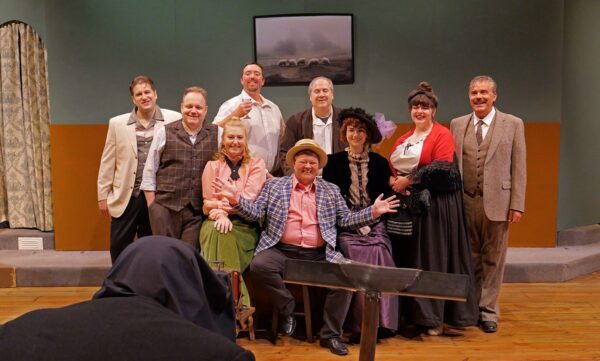
(standing) Victor Angelo, Justin Raver, Matthew McConville, Bruce Carmen, Shyan DeVoss, Mischa Hooker. (seated) Tori House, Samuel Carrington, Kassidy Holdridge.
Kingry originally envisioned building an immense rear wall from scrim cloth and making “the magic” happen with a lighting effect.
“But the deeper I got into in, the more obstacles we encountered, such as the lack of depth behind the wall to place the necessary instruments, and the fact that two big sections of the audience would be seated at right angles to the wall. As people’s seats placed them and further off-axis from a direct line-of-sight view of the wall, they might be increasingly less able to see what was being revealed behind it,” she said. “With the high cost of scrim cloth, I really couldn’t justify the expense of an effect that might not be clearly visible to a very large part of the house, which meant completely re-imagining the effect. I think the team has put together an effective solution.”
The cast features Victor Angelo, Bruce Carmen and Matthew McConville (Geneseo); Andy Schaser (Cambridge); Justin Raver (Kewanee); Kassidy Holdridge, Mischa Hooker, Tori House (Davenport), Shyan DeVoss (Rock Island), and Samuel Carrington (Galesburg).
Actors’ impressions of the play
Raver plays young Picasso and Hooker is young Einstein.
Raver said by email that Kingry’s shows are always top-notch. “She picks great shows, stages and lights them creatively, and she knows how to make an actor look good. I knew that if there was a part for me, I wanted to be a part of one of her productions. I actually focused on a different part at auditions, but was offered Picasso, which was a surprise and an honor.”
Raver didn’t know anything about the play before, but knew about the artist, but almost nothing of the man.
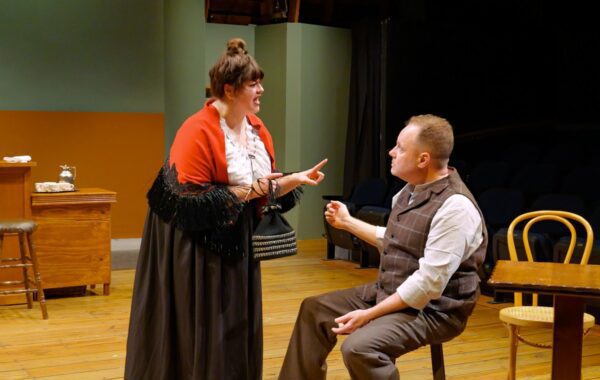
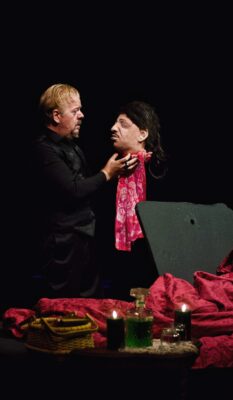
Shyan DeVoss and Justin Raver in “Picasso at the Lapin Agile” at Richmond Hill Players, Geneseo.
“The script by Steve Martin is a caricature of the man, but there is truth in such portrayals,” he said of Picasso in the play. “He was a ladies’ man and an eccentric, which is very fun for an actor to portray. The best part though is the cast. This show is a rare one. Everyone in the cast is just wonderful, especially Mischa. Playing alongside him has been great. Einstein’s quirkiness is such a contrast to the very serious Picasso and the contrast sets the tone for the characters and just makes it a good time. The patrons will feel that energy and enjoy it.”
“It is very Steve Martin. Smart, silly, and fun while breaking the characters down to their essence to tell a funny and strange story,” Raver said. “You can hear the author in the lines. Some plays just feel like their writers. Arthur Miller, Agatha Christie, writers like that were you can know the writer just by hearing the lines of dialogue. This is much the same. The show blends the earnest ideas of the era with a bit of satire and zaniness and pulls it off well.”
“I’ve been a fan of Steve Martin for quite a while, like a lot of people, and had heard something vaguely about this being a fun play, although I had never read it or seen it on stage before,” Hooker said. “I read through the script earlier this year and really enjoyed its cleverness and the way it looks in a light yet profound way at questions about life and art. I’ve also always been a bit of a fan (if that’s the right way to put it!) of Albert Einstein, partly because of his enormous importance for modern science and partly because of his playful personality.
“I really enjoy plays that speak to the connections between science and culture more broadly (e.g., Copenhagen, Constellations). So, the thought of playing Einstein was particularly intriguing to me,” he added. “In any case, after playing my first role at RHP two years ago, I had been looking for another opportunity to do that again before too long.”
Hooker said it’s interesting to consider how much of famous people’s “whole” persona is already there in a nutshell at this early stage.
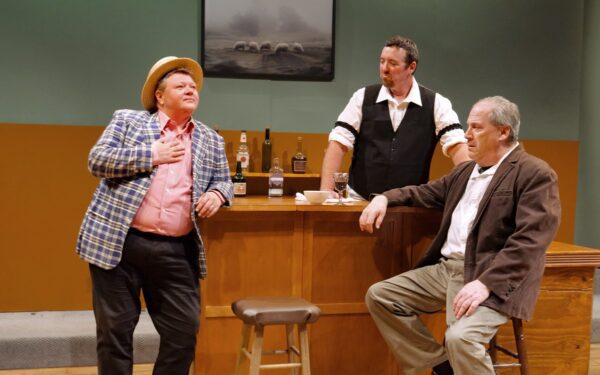
Samuel Carrington, left, Matthew McConville, and Bruce Carmen.
“I’ve been reading a biography of Einstein as part of my preparation for the role, and one thing that is striking is that by the time of the play’s setting, he had basically worked out the main ideas that were the fundamental game-changers he put out there, so although he was more or less unknown and would of course continue to refine and expand his thoughts, he was already ‘all there’,” he said. “I think that is partly reflected in Einstein’s line that says he realized at an early age that he is ‘the kind of person who will always look eighty-six.’ Although it’s overtly in reference to his physical appearance, I kind of take it as also more symbolically. Of course, he’s not outwardly everything he would later become, so there’s a line to walk.”
“It presents some really significant material easily and engagingly,” Hooker said of the play. “The way it was written focuses very strongly on the 20th century, since the setting of the story is 1904, and the play premiered in the mid-‘90s. But I do think that what the play speaks to as 20th-century issues are still very much with us in the 21st century, both as to the nature of science and the significance of art.”
The pros and cons of RHP
Hooker said that ironically, the only other show he’s done at RHP was staged the same way (with a section of seats removed), which was “84 Charing Cross Road,” in 2024.
“Jennifer Kingry is very good about organizing that space in ways that make sense. Also, there’s a bit of a mental block doing a show in Geneseo when I live in Davenport, since it’s a bit of a drive, but really, once I get in the swing of it, it’s really not that far — and the same thing applies to audience members as well,” he said.
“Richmond Hill has been a home to me for many years now. I have been in many shows and directed a few as well. Being in that space is comforting to me and this show is no different,” Raver said. “The challenges are mainly the nature of theater in the round. Staging a show in the round is unlike staging a show on a traditional stage. It creates complexity of movement where blocking becomes far more important than it is in another theater. Blocked poorly, the actors screen themselves from the audience and leave a section without a clear view. That is always one of the challenges of RHP.
“The thrills are twofold. The first being the creative use of lights and sound,” he added. “Jennifer is one of the best directors in the area. She knows the RHP sound and light system better than anyone. When I direct, I ask her to design and run my tech because I know she can pull off the effects I need to communicate my vision to the audience.”
“This show has some great use of sound and lighting and that makes it thrilling for the actors and the audience,” Raver said. “The second thrill is the other actors. I have been in shows where the experience has not been the best. Personality conflicts, or frustrations with levels of preparedness can really put the damper on the experience. This show is free of such things. Everyone has been learning and moving forward together. It has been a joyful experience, and I have had fun just about every rehearsal.”
Thursdays, Fridays, and Saturdays, the doors open at 6:30 p.m., with the show beginning at 7:30 p.m. Sundays are 3 p.m. matinees with the doors opening at 2. Reservations are recommended and can be made by calling the Richmond Hill box office at 309-944-2244 or by visiting the website at rhplayers.com. Admission to all performances is $12.
An audio description performance will be held Friday, Aug. 21. Richmond Hill also offers Assistive Listening Devices (ALDs), which can be requested at the time that reservations are made.









Leave a Reply
You must be logged in to post a comment.