

REVIEW: Music Guild Packs an Entertaining, Emotional Gut Punch in Flawless New “Cabaret”
I have long felt a kinship to the landmark, iconic musical “Cabaret,” for many reasons – my family heritage is Jewish; its amazing composer John Kander graduated from the same college I did (Oberlin, albeit 35 years earlier); I’ve been a huge fan of much of the melodic, heartfelt score (including the classics “Wilkommen,” “Mein Herr,” “Maybe This Time” and the title tune), and I had the unforgettable privilege of playing piano in the on-stage band for the 2018 St. Ambrose production, directed by the incomparable Cory Johnson.
So I was thrilled to be able to see the invited dress rehearsal of Music Guild’s new production of “Cabaret” this past Thursday, and absolutely nothing about it reflected “rehearsal.” It was flawless, fearless, fully realized and ready to open. and I genuinely hope it had a packed opening weekend, because it clearly deserved it. WOW!
Directed by the passionate Luke Vermiere (who’s clearly done his research on the disturbing history that forms the show’s backdrop and setting, and for whom I played for his Guild “Sweeney Todd” and “Escape to Margaritaville”), every single leading cast member and energetic ensemble member is perfectly cast and the show works on every one of its many levels.
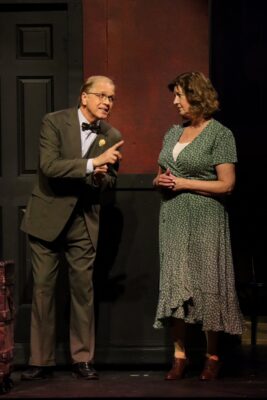
Kevin and Valeree Pieper in Music Guild’s new “Cabaret.”
Vastly, relentlessly entertaining; a bittersweet and heartbreaking dramatic tragedy; romantic, sexy, theatrical, a plea for tolerance, and a reflection of a tumultuous political time that has chilling echoes to today (where another authoritarian is leading our government, stoking hatred and intolerance)
“Cabaret” may not be a “feel-good musical,” but sure is a “feel-everything” one. One of my favorite musical memories is accompanying the multi-talented Shelley Cooper (an Augustana College theater professor, director and performer) in “Maybe This Time” at a Davenport concert in 2018. Over four years later, she directed a stunning “Cabaret” at Augie’s Brunner Theatre, and my November 2022 review led with this:
“The greatest art can – but certainly doesn’t simply – uplift us, inspire us, comfort us, and reflect the best of ourselves. Great art must also force us to think, confront pain, suffering, evil, and the worst of ourselves.”
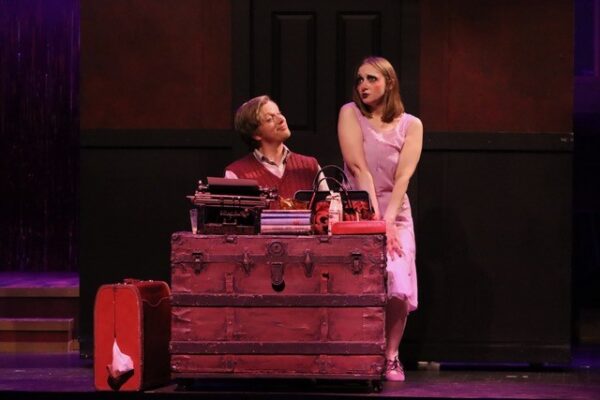
Dan Williams and Steph Moeller in the “Perfectly Marvelous” scene in “Cabaret.”
This year is the 60th anniversary of the 1966 John Kander-Fred Ebb musical, and Music Guild’s new version is just 13 years after the last time it was staged at Prospect Park, which seems a lifetime ago – that version directed by Bob Williams, starring Bryan Tank as Emcee, Melissa Anderson Clark as Sally (“the toast of Mayfair”) and Tristan Tapscott as Cliff. I have a terrible memory, but that Music Guild production seems like it was more quaint and innocent, compared to the more devilish, depraved and debauched version now back and prowling in Moline.
In a Berlin nightclub, as the 1920s draw to a close, a garish Master of Ceremonies (here embodied with a possessed, feverish glee by John Whitson) welcomes the audience and assures them they will forget all their troubles at the Cabaret, the Kit Kat Klub, where “everything is beautiful.” With the Emcee’s bawdy songs as wry commentary, “Cabaret” explores the dark, heady and tumultuous life of Berlin’s natives and expatriates as Germany slowly yields to the emerging Third Reich, according to a synopsis.
Cliff, a young American writer newly arrived in Berlin (fittingly and perfectly played by Bob’s son Daniel Williams), is immediately taken with English singer Sally Bowles (a revelatory Stephanie Moeller). Meanwhile, Fräulein Schneider (a cynical, world-weary Val Pieper), proprietor of Cliff and Sally’s boarding house, tentatively begins a romance with Herr Schultz, a mild-mannered fruit seller who happens to be Jewish (tenderly, winningly played by Val’s real-life hubby, the Guild veteran Kevin Pieper).
Key, colorful roles are also executed with precision and deep impact by Drew DeKeyrel as Ernst Ludwig (a helpful friend to Cliff who we see go to the dark side), and Madison Duling as the flirty Fräulein Kost (who likes to entertain behind closed doors).
Even though Music Guild last did the show in 2013 (and St. Ambrose and Augie have both done it in more recent years), Music Guild wanted to bring back a newer version, which was updated in 1998. “Cabaret” is licensed under three main versions – the original, from 1966, the 1987 and 1998, and has been revived many times in professional productions around the world.
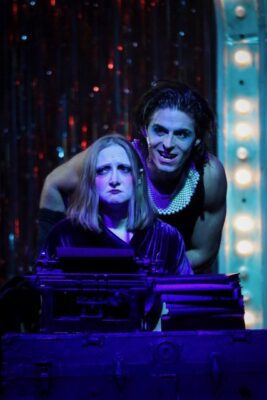
Steph Moeller with John Whitson.
The ’98 Roundabout Theatre Company revival mostly played at Studio 54 in New York, and it ran a total of 2,377 performances, becoming the third longest-running revival in Broadway musical history, third only to Oh! Calcutta! and Chicago (another Kander & Ebb triumph). Alan Cumming reprised his role as the Emcee, opposite Natasha Richardson as Sally, John Benjamin Hickey as Cliff, and Ron Rifkin as Herr Schult
As he did for his most recent directing gigs at Guild (“Sweeney Todd” in fall 2023 and “Escape to Margaritaville” in spring 2025), Vermeire also covered the orchestra pit now, bringing the action closer to the audience, and has the band on stage, on a second level.
The tight, talented band (led by music director Matthew Reece, who’s on accordion, and Mitch Carter on piano) is highlighted at the top of Act II, with the Entr’acte and a Kick Line, including a stylish, snazzy and brassy first version of the jaunty “Cabaret,” which really isn’t that way when Moeller sings it solo near the show close.
While Moeller has been in several Guild musicals (“Elf,” “King and I,” “Disaster,” “RENT” and “Sweeney Todd”), most of her theater experience is straight plays. I had never seen her take on a musical mountaintop of this scale before, and she definitely rises to the challenge – grabbing Sally by the throat from the start and never letting go.
She starts as brash and confident, and as an aspiring actress, we admire her dream to become someone mysterious, fascinating, have lots of passionate affairs, to be ravishing, sublimely seductive, and live life with reckless abandon.
In an adorable blonde bob, irresistible smile, and sparkly, glittery eye makeup, Moeller dazzles in the early exuberant, exhilarating “Don’t Tell Mama” and “Mein Herr” with the six Kit Kat Girls, and one of my favorite scenes is her budding romance with Williams in “Perfectly Marvelous,” where he is her straight-laced, more shy and common-sense boyfriend.
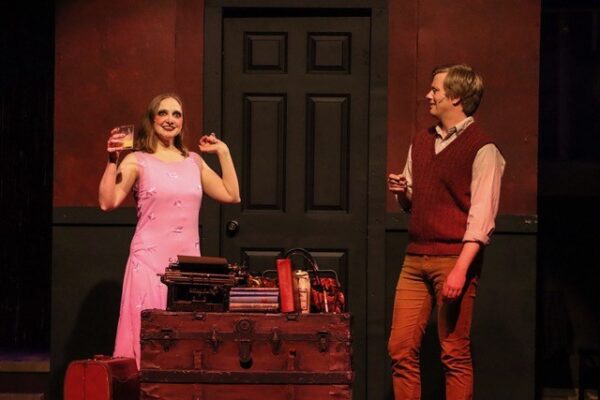
Stephanie Moeller and Danel Williams as Sally and Cliff.
Sally wants to watch Cliff write, and she’s like a dizzy, manic puppy tugging at his feels, and we see her open-minded philosophy, which forms a stark contrast to the story’s villains. While “Perfectly Marvelous” isn’t a true duet (Williams briefly reveals his strong singing voice), but it’s so cute and endearing.
From the start of “Cabaret,” Whitson dominates as the sexually fluid, flamboyant Emcee, especially in his spectacular opener, “Willkommen.” He occasionally reappears to add fireworks to the proceedings (the structure of “Cabaret” is dual tracks, with the wild flash and uninhibited showmanship in the Kit Kat Klub scenes, and more drama in the predominantly dialogue-heavy and more drab songs in the Berlin boarding house scenes). Kim Munn provided delightful choreography.
Whitson is like a slithering snake, often with a frenzied glint in his eyes, and his many highlights include “Two Ladies” — which inexplicably only features one lady, Anna Bourke as Lulu, and the other (both wearing apron outfits) the gay Bobby, played by Tyler Belanger, still lots of fun – plus “Money,” with Kit Kat girls and flying bills; “If You Could See Her,” with Rebekah Riewerts in the gorilla outfit; and the creepy, haunting, ethereal “I Don’t Care Much” late in the show.
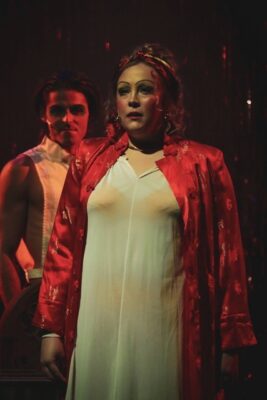
John Whitson as Emcee and Madison Duling as Fraulein Kost.
Fleeting moments that are also profound under Whitson: first, the Act II reprise of “Married” when he breaks glass at the mock Jewish wedding of Schneider and Schultz, matched by shattering of a shop window (immortalized in the Nazis’ Kristallnacht in 1938, when windows of Jewish-owned stores, buildings, and synagogues were smashed), and second, near the end of the show (after conflicts with Nazis have emerged), where Whitson returns and asks the audience, “Now, where are your troubles? Gone.”
The very last scene (which I won’t reveal) is a real gut punch, when the Emcee removes his long coat. Unfortunately, there are no bows or post-show cast greetings.
The Piepers’ performance also is just what’s needed, understated and decent and kind, the true moral exemplars (along with Cliff) of this difficult tale. “Married” (near end of Act I) is lovingly sung by Duling as the Piepers sweetly dance, and the disco ball over the audience is spotlit and its spinning reflections mesmerizingly swirl about the theater.
Moeller’s terrific numbers include the well-known heartbreakers, “Maybe This Time,” and “Cabaret,” which show off both her bitterness and anger, but also wide-eyed optimism and hope.
Partly by coincidence, Music Guild is presenting back-to-back popular musicals that revolve around Nazis, after “The Sound of Music” (1959) last fall, which reflects the von Trapp family’s ability to flee Nazis as they invaded Austria in 1938. That clearly ends in hope, but “Cabaret” (though set eight years earlier, before Nazis came to power) is much different, “a story about people that didn’t have a choice but to stay,” Vermeire said. “ ‘Sound of Music’ is about when they started invading other countries and when things got so bad.”
“The reality of the Holocaust is always the background thought of ‘Cabaret,’ but it’s really a show about the moment before when it wasn’t too late,” he said, noting he researched a Scott Miller book on theater, reflecting on the Holocaust.
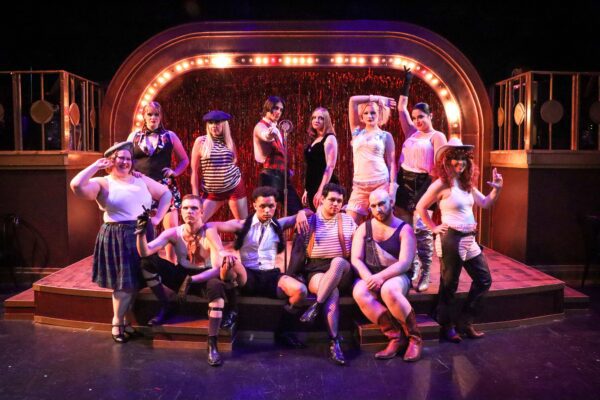
Performers at Berlin’s Kit Kat Club in Music Guild’s “Cabaret.”
In the Guild program, virtually his entire director’s note quotes Miller’s 1996 “From Assassins to West Side Story,” on what “Cabaret” has to teach us today. Cooper in 2022 said the show was very relevant to current times, but even 30 years ago, Miller saw similarities.
“The extermination of the Jews started small, in tiny, daily indignities, in little, nearly unnoticeable acts of prejudice,” Miller wrote. “Could the same thing happen today? Of course it could. Right-wing political leaders today say pretty much the same things the Nazis said about gays, women, family, religion, culture, education and patriotism. It may not seem dangerous right now, but it didn’t seem dangerous in Germany in 1930 either.”
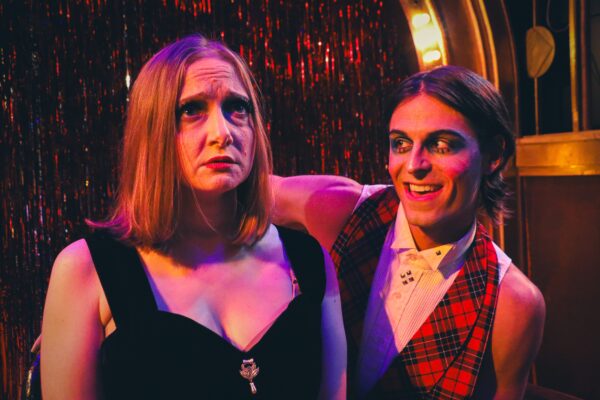
Steph Moeller and John Whitson in “Cabaret,” running at Prospect Park in Moline April 10-19, 2026.
Miller and “Cabaret” – in one of its numbers that confront the audience – ask, “What Would You Do?” In 2026, when our political climate seems a million times more hurtful, hateful and bitterly divisive than 1996, we still have choices and we can still vote for something better. Kander, an exceedingly decent Kansas City native, who is still around now at 99, would want us to learn from “Cabaret,” to be better.
Performances of “Cabaret” will continue at 7:30 p.m. on 17 and 18, with a final show at 2 p.m. Sunday, April 19. Tickets are $20 for adults, $15 for children (12 and under), available by calling the box office at 309-762=6610 or by visiting the QCMG website, www.qcmusicguild.com.

Stephanie Moeller plays Sally Bowles in Music Guild’s new production of “Cabaret.”











Leave a Reply
You must be logged in to post a comment.