
Quad Cities Celebrates Banned Books Week With Free Speech Pioneer
When free speech apparently only applies to red America, and the First Amendment is under attack on many fronts, it was with renewed urgency that the annual Banned Books Reading was held Monday night at the Rock Island Public Library, Watts-Midtown Branch.
Part of national Banned Books Week, the local Banned Books Read Out is a Rock Island library tradition for over 20 years, and the problem seems to be getting worse, library director Angela Campbell said. She is also vice president of the Midwest Writing Center (based at the Rock Island Downtown Library), which presents the annual reading of banned or challenged authors.
On Monday, Campbell read from a children’s book a parent recently complained about, called “Fred Gets Dressed” (2021) by Peter Brown. The book is about a boy who loves to “romp through the house naked and wild and free” and tries on his mother’s clothes. Brown, a bestselling author of children’s books, is a straight, cisgender man who wrote the book about an experience he had as a little boy.
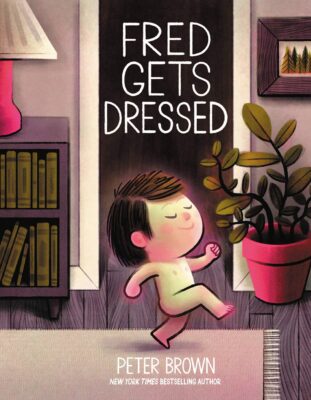
The cover of the children’s book “Fred Gets Dressed,” by Peter Brown, which has drawn a complaint at the Rock Island Public Library.
“Controlling what other people can read, that’s downright un-American,” Campbell said. “I think everyone needs to lighten up and let children be whoever they’re going to be, and let them read what they want to read. Everything is going to be fine.”
Midwest Writing Center executive director Ryan Collins said Monday that censorship is on the rise worldwide, including murdering of journalists in places like Gaza and removing information from the Smithsonian website.
“All book banners and censors, to my mind, have two things in common – they’re selfish and they’re cowards,” he said. “It’s important to remember that. We’re all afraid, we all have fears. But our fears do not give us license to tell other people what to read, and how to deal with their problems.”
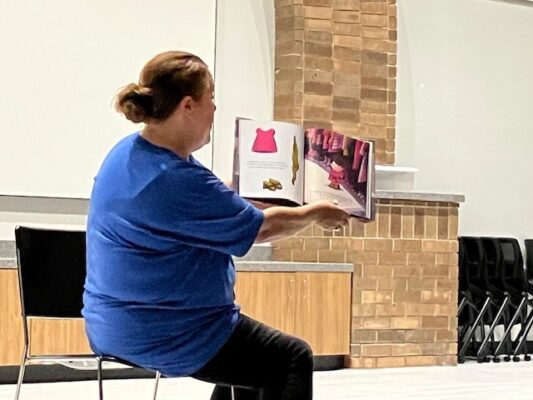
Rock Island Public Library director Angela Campbell reads from “Fred Gets Dressed” at the Banned Books event in the Watts-Midtown branch auditorium, Oct. 6, 2025 (photo by Jonathan Turner).
Collins later read a poem from the controversial English professor Joshua Clover, of University of California-Davis, who passed away this past April at 62. He was a communist and politically active, and earned his master’s from the University of Iowa Writers’ Workshop.
Collins noted another form of censorship is the Turning Point USA Professor Watchlist, which targets professors that are accused of discriminating against conservative students and advancing leftist propaganda in the classroom. Turning Point founder and free-speech activist Charlie Kirk, 31, was murdered Sept. 10 at a Utah university, sparking more intense debate about free speech in the U.S.
Banned Books Week is Oct. 5 – 11, 2025. In 1982, the American Library Association and a coalition of other organizations launched the week in response to a sudden surge in the number of book challenges in libraries, schools, and bookstores. From 2021 to 2024, those censorship efforts have redoubled.
Last year, 2,452 unique titles were challenged, the third highest number ever documented by ALA and significantly exceeding the annual average of 273 unique titles over the period from 2001–2020.
“The 2025 theme of Banned Books Week serves as a reminder that censorship efforts persist to this day,” ALA president Cindy Hohl said. “We must always come together to stand up for the right to read.”
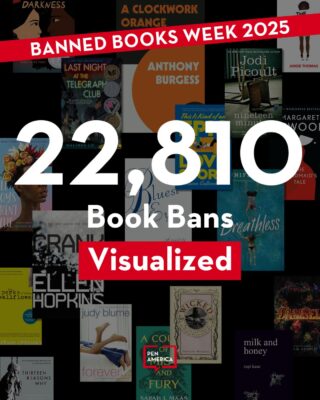
There were 22,810 instances of book bans in U.S. public schools from 2021 to 2025.
In a new report (“The Normalization of Book Banning”), PEN America found 6,870 instances of book bans across 23 states and 87 public school districts in the 2024-2025 school year. PEN America works to promote freedom of expression in the literary space.
According to the report, which was released ahead of Banned Books Week, Florida had the highest number of book bans with 2,304, followed by Texas with 1,781 bans and Tennessee with 1,622.
“In 2025, book censorship in the United States is rampant and common,” PEN America said. “Never before in the life of any living American have so many books been systematically removed from school libraries across the country. Never before have so many states passed laws or regulations to facilitate the banning of books, including bans on specific titles statewide. Never before have so many politicians sought to bully school leaders into censoring according to their ideological preferences, even threatening public funding to exact compliance. Never before has access to so many stories been stolen from so many children.
“The book bans that have accumulated in the past four years are unprecedented and undeniable,” the report said.
Monday’s Rock Island event featured 12 readers presenting work by a variety of authors from Shel Silverstein to Art Cullen, and Mark Twain to Ellen Hopkins, including one special guest from New York – free speech pioneer Steven Pico.
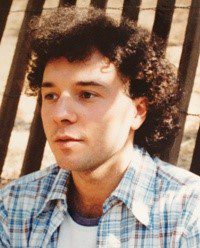
New York native Steven Pico in 1981.
In 1977, at age 17, Pico became one of the founders of the freedom to read movement in the U.S. by positing that censorship of literature violated the First Amendment and by serving as the plaintiff in the critically-important case Board of Education v. Pico — the first lawsuit of its kind.
When he announced his legal challenge to the removal and banning of 11 books from the public schools in Island Trees, N.Y. (a New York City suburb), Pico warned all Americans about the dangers posed by censors who sought to deny and rewrite history. He emphasized that book banners seemed particularly motivated to silence the voices of authors from the African-American, Jewish, LGBTQ+, Native American, Hispanic, Asian and other communities.
Pico had been elected Student Council President at the end of his junior year in high school and during the months before becoming a senior he formulated a novel concept that book censorship in schools transcended the authority of local and state officials and could be contested in Federal courts as a violation of the U.S. Constitution.
Five months before his high school graduation and with acclaimed author Kurt Vonnegut Jr. by his side, Steven announced and set in motion what would become the most successful and consequential challenge to book banners in American history. Two years later, at 19, Pico served on the Board of Trustees of his local public library, and at age 20 he represented New York State as a delegate to the First White House Conference on Library and Information Services.
Pico went on to study English Literature and Political Science at Bryn Mawr and Haverford colleges, where he championed the Quaker practice of non-violent activism to thwart injustice and to advance the rights to freedom of inquiry, thought, and expression for all American residents.
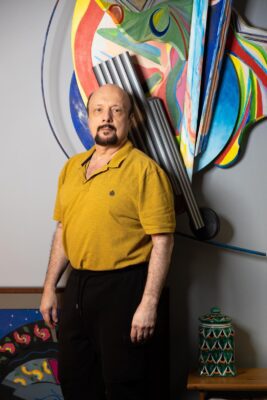
Pico, 65, is a visual artist by profession, and will speak at the Augustana College Symposium Day at noon Wednesday, Oct. 8, 2025.
For the past 50 years, Pico has spoken out nationwide, and organized at the community and state level, about the importance of defending our Constitutional liberties. After receiving his B.A. from Haverford, Steven worked for three years at the non-profit National Coalition Against Censorship, during which time he worked with the Legislature in his home state to pass a law protecting the privacy rights of all library users in New York State.
When he was 26, The New York Times described Pico of “Pico v. Island Trees fame” as a “Hero to civil libertarians” and yet fame seemed to be one thing that held the least interest and value to Pico.
Only book ban case to the Supreme Court
The Federal district court judge who made the first ruling in the Pico case sided with the board of education, stating that while the board used a “misguided educational philosophy” it had acted within its authority.
Pico appealed and was handed an impressive victory by the 2nd Circuit Court of Appeals, where the majority of judges felt that the evidence presented by Pico indicated that the school board had tried to suppress ideas. The Court of Appeals overturned the first ruling and ordered a full trial to precisely determine why the school board had removed 11 books and permanently banned 9 of those books.
The Island Trees Board of Education, however, was eager to avoid a trial focused on its political, religious, and moral motivations behind the banning, and so the school board appealed directly to the U.S. Supreme Court, which accepted the Pico case.
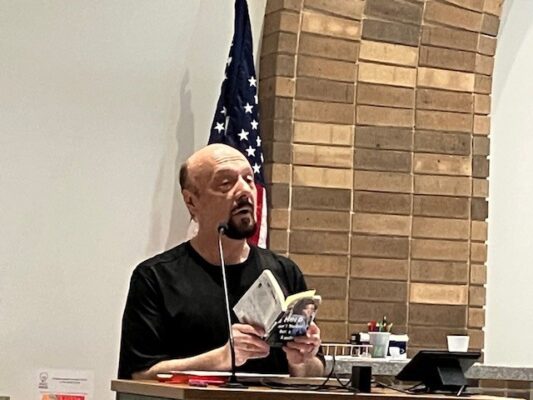
Steven Pico reading from “A Hero Ain’t Nothin’ But a Sandwich” at the annual Banned Books Read Out at Rock Island Public Library’s Watts-Midtown branch Oct. 6, 2025 (photo by Jonathan Turner).
The Board of Education had labeled the 11 books “anti-American, anti-Christian, anti-Semetic [sic] and just plain filthy.”
Pico’s endeavor to protect literature from being censored took over five years to reach the High Court, in 1982, where the Justices were deeply divided on the matter. Steven was victorious by winning the explicit support of four Justices — William Brennan Jr., Thurgood Marshall, John Paul Stevens, and Harry Blackmun (who had authored the majority opinion in Roe v. Wade in 1973) — and the tacit support of Justice Byron White.
“Our Constitution does not permit the official suppression of ideas,” Justice William J. Brennan Jr. wrote in the principal opinion from Board of Education v. Pico (1982). In his opinion, Brennan also wrote in the Pico case, “we hold that local school boards may not remove books from school library shelves simply because they dislike the ideas contained in those books.”
Following its defeat at the Supreme Court, the Island Trees Board of Education voted to return all of the banned writings — which included a 1729 essay by Jonathan Swift, popular titles such as Slaughterhouse-Five and Go Ask Alice, the Pulitzer Prize-winning novels The Fixer and Laughing Boy, a short story by James Baldwin, an essay on Malcolm X, and works by Richard Wright, Alice Childress, and Langston Hughes — to its school library shelves for unrestricted use by students, librarians and teachers.
A Bettendorf boy and Augustana College
Impressed by Pico’s continued and articulate expression of his ideas and beliefs, and his courageous advocacy for the First Amendment rights of educators, students, publishers, librarians, and authors, the faculty at Augustana College invited Pico to make a presentation on Symposium Day (the theme is “Voice and Vision”) on Wednesday, Oct. 8, 2025.
Though Pico has lectured in the past at institutions both small and large — such as Rhodes College in Tennessee and Columbia University in New York — he has generally shied away from the limelight. Instead, over the past five decades he has preferred to engage with students and educators in a more personal, direct, and interactive manner, and encourage action at the grass-roots level in communities across the country.
The Augustana faculty and community are pleased to welcome Pico to campus in the hope that his presence will humanize a famous court case and, perhaps, inspire students to consider passions they may pursue on and off campus as they work towards a degree.
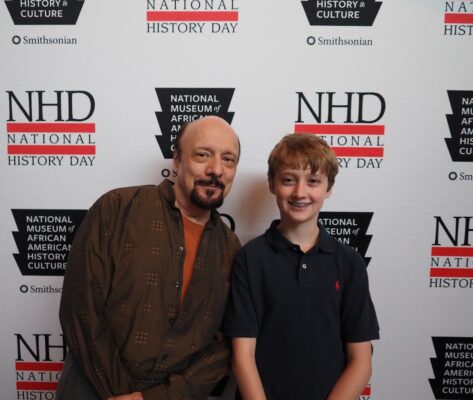
Steven Pico and Adrian Gillette at the National History Day celebration in June 2025 at the Smithsonian’s National Museum of African-American History and Culture in Washington, D.C.
By profession, Pico is a visual artist (specializing in graphic mediums, sculpture and painting) and he has pursued other career interests in architectural design and as an editor, and through non-profit projects to encourage the appreciation of art for both enjoyment and as a form of therapy that promotes well-being.
His week in the QC was sparked by a request early this year by then-Bettendorf 7th grade student Adrian Gillette.
The 13-year-old from Bettendorf — son of Meg Gillette, who is chair of the Augustana College English department — wanted to make a short documentary about the banned books Supreme Court case. Adrian contacted Pico early this year, passionate about freedom of speech.
“I respected the intelligence and the cleverness of this 13-year-old to want to speak to primary sources,” Pico said in an Oct. 4 interview on WVIK’s “Saturday Morning Live. “He not only wanted to speak to people on the front lines, but he wanted to do so in an empathetic, and non-judgmental manner.”
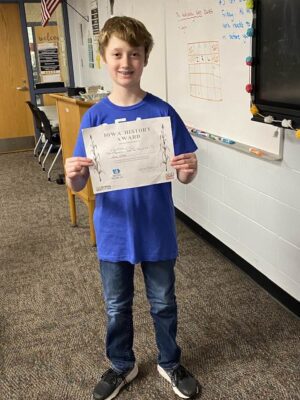
Adrian Gillette, 13, a Bettendorf Middle School student, won first place in the Iowa competition for National History Day, for his 10-minute documentary on the New York banned book case that reached the U.S. Supreme Court in 1982.
“He really inspired me and this led to something else,” Pico said. The project he was working on was for National History Day (which involved 500,000 students), and also lost all federal funding support. “Adrian wanted to do a story about my lawsuit.”
The Bettendorf student won the Iowa state competition with his 10-minute documentary, and finished in the top 3 at the national finals in Washington, D.C. Adrian got to be included in a virtual workshop by acclaimed documentary filmmaker Ken Burns.
“We teach kids what to be afraid of, who to be afraid of, how to protect themselves,” Pico said. “Which is great, but we need to spend as much time telling students there are good people out there, who are not predators, who want to help.”
“I believe in serendipity,” he said on WVIK. “I’m coming to your community – I don’t really know why I’m coming to your community to be honest, because I don’t know where it’s gonna lead.”
Adrian’s film was shown this past June (among 18 student works) at the National Museum of African American History and Culture in Washington, D.C., attended by Pico. “He had a passion and he found his voice,” he said of the seventh-grader. You can watch the video HERE.
Recognition “for a lifetime of fighting against censorship”
Having been recognized in the past by the Writers Guild of America, East, for “his valiant fight against censorship” and by the American Library Association for “strong commitment and defense of the principles of intellectual freedom and the freedom to read,” Pico was honored in November 2023 with the NEW PRESS Social Justice Award “for a lifetime of fighting against censorship.”
Established in 2010 to recognize “individuals whose creative contributions have had a lasting impact on our society,” past honorees of the Social Justice Award have included Alice Walker, Harry Belafonte, Pete Seeger, and Toni Morrison. When Maryland Congressman Jamie Raskin learned that Steven was chosen to receive this award in 2023, he released the following statement:
“Censorship is the hallmark of authoritarianism. It’s no wonder, then, that some of the most commonly banned books are those that serve as cautionary tales about authoritarian states like Orwell’s 1984 and Atwood’s The Handmaid’s Tale. And of course, as the Court wrote in Board of Education v. Pico, the case arising from our very own Steven Pico, the First Amendment protects not just the right to speak but ‘the right to receive information and ideas.’
“Yet many books are now targets for censorship because they address racism or white supremacy as historical realities or because they render LGBTQ+ individuals as full human beings or because they introduce ideas about diversity and discrimination,” Raskin said. “The very act of reading invites empathy, which is why fighting book bans is not simply a defense of the First Amendment but is also a defense of the principles of solidarity and truth.”
Pico on Monday at the Rock Island library read from two of the controversial books from his case, “A Hero Ain’t Nothin’ But a Sandwich” (a 1973 young adult novel by Alice Childress about a teenage boy who struggles with abandonment and turns to drugs) and “Go Ask Alice” (a 1971 book by Beatrice Sparks about a teenage girl who develops a drug addiction).
Pico’s Symposium Day talk Wednesday at Augustana will be at noon in Olin Auditorium, titled “UNCENSORED: A Discourse on Non-Violent Activism & the State of Freedom of Expression in the U.S.A.”
The first modern Banned Books read-out was in 1982, and Pico, then 22, was one of the keynote speakers, with author Isaac Asimov (whose book, “I Robot” was challenged). “When I was their age, I was advocating for something I was passionate about,” he said on WVIK about speaking at Augustana. “This is my passion, so I’m encouraging young people and all people to choose a passion, because you may have to do that for the rest of your life.”
Pico’s case was the only book-banning case to go to the Supreme Court, and the decision didn’t solve everything, he said, but it set standards.
“We’re talking about literature,” he said on WVIK, noting his school board called Malcolm X a traitor to his country. “What scares me today is, we’re hearing that same language from the White House. We’re hearing the same words – traitor – used against politicians from the other party, against previous presidents.”
Now the issue has become partisan and political, including governors calling for book bans, to scare voters and scare parents, to get elected, Pico said.
Iowa book banning
In May 2023, Iowa Gov. Kim Reynolds signed a sweeping education law that orders the removal from schools of books that contain sex acts and restricts teaching about LGBTQ topics. The Iowa ACLU filed suit and won a temporary block on the law, and several schools returned banned books to shelves – but many others didn’t.
This past May, a federal judge again temporarily blocked portions of the Iowa law aimed at restricting schools’ recognition of LGBTQ+ people and banning books with sexual or LGBTQ+ content. The 10 most banned books in Iowa schools are:
- Nineteen Minutes by Jodi Picoult
- Looking for Alaska by John Green
- Sold by Patricia McCormick
- Thirteen Reasons Why by Jay Asher
- The Perks of Being a Wallflower by Stephen Chbosky
- The Kite Runner by Khaled Hosseini
- Crank by Ellen Hopkins
- The Handmaid’s Tale by Margaret Atwood
- Identical by Ellen Hopkins
- The Color Purple by Alice Walker
In Iowa, the effect of the 2023 law is aiming to remove all literature by gay and lesbian authors from school libraries, which was not part of the law, Pico said.
You can’t exclude one class of authors from a school, he said. “I think it’s kind of sad what’s happening in Iowa, even in grades 6 and younger.”
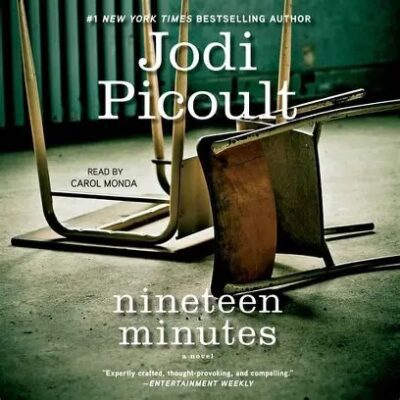
“Nineteen Minutes” (2007) by Jodi Picoult, the first book by the author to debut at No. 1 on The New York Times Best Seller list. The most banned book in Iowa, it follows the unfolding of a school shooting, including events leading up to and the aftermath of the incident.
Book banning does not protect anyone; it just leaves young people defenseless, he said.
“I don’t believe we should divide our communities and have parents against their teachers and librarians, to create this kind of distrust,” Pico said. “We talk about parental rights – what about my parents’ rights? They wanted me to have a well-rounded education. They trusted my teachers; they trusted my librarians and they wanted all ideas to be discussed in the schools, in an age-appropriate level, to have a well-rounded education.”
In Island Trees, the school board got a list from outside the community — there were no board or parental complaints about any of these books. They called the “Hero” book anti-American, because a teacher tells a student that George Washington owned slaves.
“I don’t see how it’s morally correct or in any other way correct to rewrite American history, to not teach about slavery,” Pico said Monday. Washington ordered his slaves be freed following his death.
The reason why book banners lost their case is they excluded books based on their position on the school board, Pico said. “They thought because they were elected by a majority of the people, they could do whatever they wanted. That’s not the way the First Amendment works.”
The society protects minority voices from being censored, he noted, and as a 17-year-old, he wanted to win this case. People can’t just exclude things they disagree with.
The American Library Association offers a variety of free downloads, resources, and materials to support Banned Books Week activities at www.ala.org/advocacy/bbooks/banned. To learn how to fight against book bans, click HERE.



Leave a Reply
You must be logged in to post a comment.