

New Documentary Honors Silvis Family, U.S. Military Service
For over 70 years, the Korean War (1950-53) has been called “The Forgotten War,” but a new documentary offers illuminating insight into the conflict and how it dramatically impacted one Quad-City family.
Johnny Munos, a 23-year-old from Second Street in Silvis (home to many Mexican-American immigrants), was among the 36,574 U.S. military killed in Korea, the war whose armistice left in place the communist North Korea and democratic South Korea that exist to this day.
The new half-hour film, “The Last To Fall From Hero Street: The John Munos Story,” premiered Saturday (Nov. 8) at Davenport’s Putnam Giant Screen Theater by Moline-based Fourth Wall Films. Filmmakers and spouses Kelly and Tammy Rundle are in the middle of completing their planned nine-part documentary series that aims to tell the inspiring, tragic tales of the young men (six in World War II and two in Korean War) from Hero Street who lost their lives serving their new country.
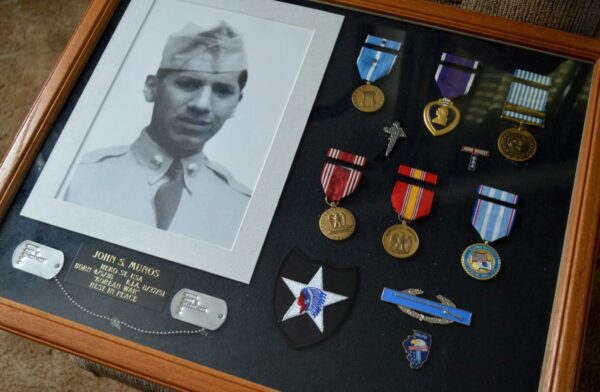
John Munos (who was killed at 23 in the Korean War in August 1951) and his Army medals.
The Hero Street series explores the compelling true story of eight Mexican-American heroes from Hero Street: Tony Pompa, Frank Sandoval, William Sandoval, Joseph Sandoval, Claro Solis, Peter Masias, Joseph Gomez, and The Last to Fall‘s subject John S. Muños.
Muños was one of 12 siblings (one of six in his family who survived to adulthood), and was born in a Silvis boxcar in 1928. John married his sweetheart, Mary Bessera, three months before he entered the Army on January 15, 1951. A furlough allowed him to visit his wife and family one last time before deployment.
“The last time I saw him, he came to say goodbye, and I was pregnant with my fourth child,” Mary Muños Ramirez, 95, said of her brother in the film. “I sent him a picture of my new baby boy. I got the letter and picture back. He had already been killed.”
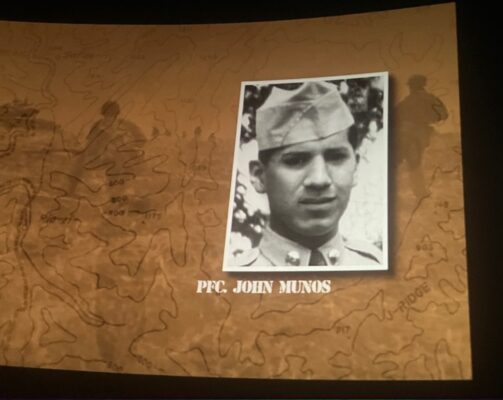
John Munos (who was killed at 23 in the Korean War in August 1951).
John served in the Korean War with Company F of the 38th Regimental Combat Team, Second Infantry Division. On August 27, 1951, at age 23, he was among 740 Americans killed in the Battle of Bloody Ridge. His body was never recovered.
Only a block and a half long, Second Street in Silvis lost more young men at war than any other street in America. Hero Street, as it was first renamed in 1967, has provided over 100 service members since Mexican-American immigrants settled there in 1929.
The Saturday showing at the Putnam was immediately preceded by the Fourth Wall half-hour doc “A Bridge Too Far From Hero Street,” chronicling William Sandoval’s story. The 21-year-old private served in the U.S. Army’s Co. F, 2nd Battalion, 504th Parachute Infantry Regiment, 82nd Airborne Division.
On October 6, 1944, Willie’s outfit was overrun while engaging the enemy near Zyfflich, Germany and he was listed as missing in action. Sandoval was officially listed as “killed in action” on October 7, 1945.
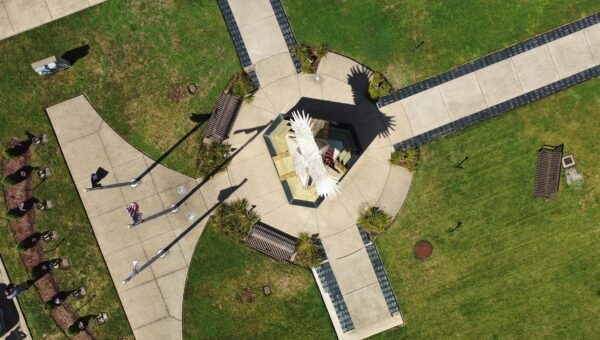
An overhead view of the Hero Street Monument in Silvis, Ill.
Brian Munos, a 58-year-old U.S. Navy veteran and great-nephew of John Munos, on Saturday thanked the Rundles “for their vision, for their commitment, for what they believe is an obligation to tell our story.”
“A lot of us here from Hero Street, we didn’t even know most of our story, even though we saw our name on that wall every day. We didn’t know the true meaning of each of the stories,” Munos said. “These two folks have taken it upon themselves to make that part of our lives, so we can see that history.”
In addition to being a great-nephew of Johnny Munos, Brian is grandson of Joe Munos (U.S. Navy), nephew of Bob Munos (Navy), nephew of Joey Munos (U.S. Marine Corps), of Richard Munos (Navy), of Arthur Munos (Army), of Mary Munos (Air Force), and cousins of others who served from Hero Street.
“To serve and give a commitment in order for our family to have a better way of life, in order to show that we are a part of something,” Brian said. “We went from a war-torn Mexico, to a railroad yard, to a block-and-a-half street built out of boxcars, and here we are today.”
His family and their military service inspired Brian and younger generations of the Munos family.
“A way of life”
“For us, being a Munos wasn’t just a name, it was a way of life,” he said. “That’s what I took from it – the pride of our family, the story of our history, what little we did know, what little we were told as kids. We knew we had some history, so the inspiration was always there, because how could I not, with what people have done for me? I recognized that at an early age, that so much sacrifice was made for me and that I have to do my very best to represent them.”
Many members of the Munos family were in attendance Saturday, two other local Korean War veterans interviewed for the new film, as well as 100-year-old Rufina Sandoval Guerrero (William Sandoval’s sister), who will celebrate her 101st birthday on Nov. 14. Kelly Rundle gave her a framed charcoal drawing that Davenport artist Bruce Walters did of Willie, which was used in his film.
Interviewee Nellie Terronez Muños, meanwhile, was 99 years old when the Rundles spoke to her in 2022 for The Last to Fall from Hero Street. (John Muños was a brother of her husband Joe.) Nellie passed away on January 26, 2024 at 100, leaving 18 grandchildren, 36 great-grandchildren, and 32 great-great-grandchildren.
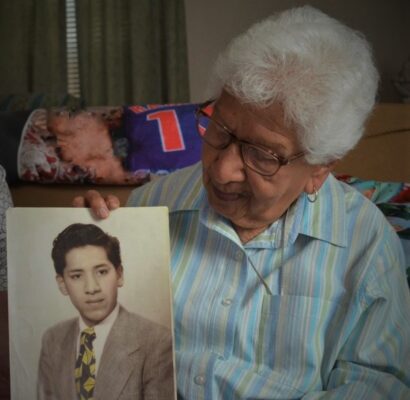
Mary Munos Ramirez (John’s sister) with a photo of John.
The new doc – the series’ fifth entry, and final tale chronologically — profiles her brother-in-law, starting with the Muños family’s journey from Mexico as they fled the Revolution. John and Joe’s father, Isabel, worked in the rail yards in Silvis, and his mother, Victoria, made their home in a boxcar provided by the railroad.
The families of the boxcar village experienced both acceptance and discrimination in their new community. At the time of the Great Depression, the families living in the railroad village were moved to Second Street in Silvis, a former dumpsite.
“We also gave hundreds of veterans who served from that street, and that cannot be forgotten,” Brian Munos said. “We have to do that come Tuesday, and we have to do that every day.”
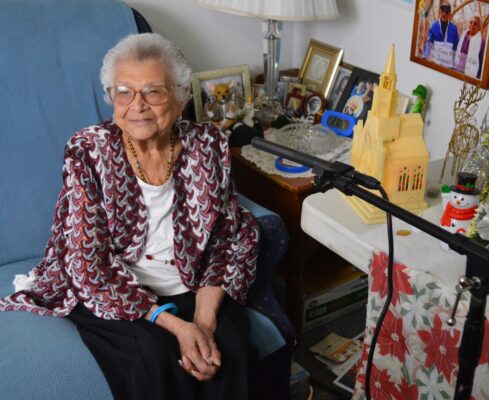
Nellie Terronez Munos (who was married to John’s brother Joe) was interviewed for the film when she was 99.
“The sacrifices of being away from your family, it hurts, and it hurts bad,” he recalled. “It hurts just as bad in the household, when that serviceman is gone, when they’re committed somewhere else.”
“Every day, a new veteran is made, who leaves the military and goes back home,” Munos said. “We gotta remember that number grows in strength and we gotta be strong for them as they come back to us. Let’s remember the families of the veterans; let’s pray for our veterans; let’s pray for those that are in need, and let’s pray that we can all come together as a community, as you see here in this film.”
“We can be great together; can live together and choose each other to protect and serve under that flag,” he said. “We still are one under that flag.”
What is a producer?
Kelly before the Saturday premiere credited his wife Tammy, the films’ producer, noting “nobody knows what a producer does.”
“I don’t know what she does sometimes, but what I do know about her is, she makes everything possible,” he said. “She makes everything happen. She takes care of all this stuff that I don’t even know she’s doing. She does all of that and she’s my creative partner, as we’re putting our projects together.”
“We’ve been doing this for a long time, the two of us, and I couldn’t ask for a better partner,” Tammy said of her husband. “He’s a creative force, and he continues to surprise me every time. I am so grateful to be your wife every day and your partner in crime.”
“We are so thrilled to have all of you here today,” she told the audience. “Our hope is our film will inform and enlighten, and inspire, but also honor Hero Street’s John Munos, and the rest of the Hero Street Eight, and their families, and the many who work tirelessly to memorialize them.
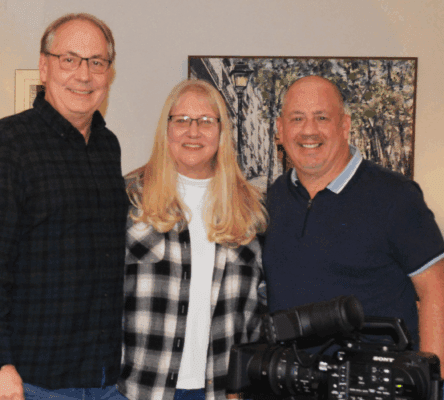
Kelly Rundle, left, with his wife Tammy and Brian Munos (John Munos’ great nephew).
“We hope you walk away today inspired by the beauty, the strength, and the important contributions of the Hispanic community, and leadership in the Quad Cities and this country,” Tammy said.
Kelly grew up in the QC, graduated from United Township in East Moline, and went to school with kids related to the Hero Street Eight, but never heard about their story, until after moving away for 25 years, and returning in 2009. He read about the Hero Street Monument and didn’t know what it meant.
A friend from grade school met Kelly at the VFW in East Moline, and saw Marc Wilson’s 2009 book, “Hero Street, U.S.A.: The Story of Little Mexico’s Fallen Soldiers,” and he immediately read it.
John Munos (who was killed at 23 in the Korean War in August 1951).
“I recognized that this was an important local history story,” he said Saturday. “But more than that, it was an important American history story. These are stories that are unique to these eight young men, and to their families, but they have a universal quality.
“You do not have to be part of this community; you do not have to be someone from Hero Street, to see situations, people, circumstances that you can identify with and connect to,” Kelly said. “We had a boxcar village in the yard in Silvis, but there were similar boxcar villages in the region.”
“Though it has been really difficult – and I would say more difficult than it should be – to make these films, we are committed to completing the process, telling the stories of all eight young men,” he said.
“I’ve been able to connect to them across the ages,” Kelly added. “I never met them, and I didn’t have that honor or opportunity. But I have appreciated getting to know them, as we try to tell their story.”
Fourth Wall Films’ A World Away from Hero Street, about Joseph Gomez, is slated for release in the fall of 2026. For more information on the series, click HERE.
The annual Veterans Day ceremony will be held at 11 a.m. Tuesday, Nov. 11, at Hero Street Memorial Park, Silvis.
Speakers will include Brian Munos, Mayor Robert Cervantes, Sgt. Major Prosser, and U.S. Rep. Eric Sorenson, D-Illinois.










Leave a Reply
You must be logged in to post a comment.