

First “Violins of Hope” Event Brings Student, Ballet Performances to the Putnam
Hope and beauty triumphed over evil and hatred in a special program Tuesday night at the Putnam Museum and Science Center, Davenport.
The free event kicked off a worldwide traveling exhibit of violins now in the Quad Cities, which reflects the power of music to heal, inspire and teach. Violins of Hope Iowa will bring a powerful cultural initiative to communities across the state through a unique collaborative residency featuring historic instruments connected to Jewish musicians and the Holocaust.
The Iowa residency in March and April 2026 will include programming in the QC, Des Moines, Sioux City and Danville, uniting museums, performing arts organizations, schools and community partners in a shared effort to preserve memory, inspire learning and promote hope through music. Musicians connected with the Quad City Symphony Orchestra (QCSO) and dancers with Ballet Quad Cities took part in the Putnam program Tuesday, showcasing historic violins in the collection.
Violins of Hope is a collection of 67 violins, viola and cello (in the Iowa exhibit) that were owned and played by Jewish musicians before and during the Holocaust. Many of the instruments survived ghettos, concentration camps and hiding and now serve as living witnesses to history. Painstakingly restored by master violin makers Amnon and Avshalom Weinstein in Tel Aviv, the instruments are returned to concert stages and educational settings so their stories can continue to be told.
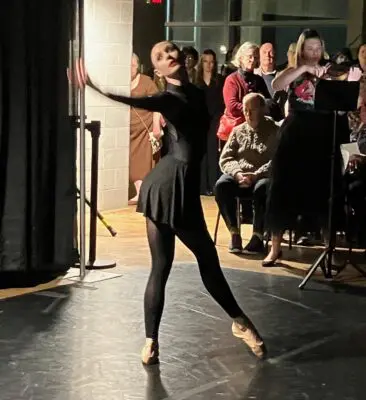
Ballet QC dancer Madeline Kreszenz performing, accompanied by QCSO violinist Emily Nash Tuesday night at the Putnam (photo by Jonathan Turner).
“This is a historic opportunity for Iowa,” said Allan Ross, executive director of the Jewish Federation of the Quad Cities, who participated in a special media preview of the project Monday at the Putnam. “Bringing Violins of Hope to multiple communities across the state allows us to reach diverse audiences and create meaningful connections. This residency is about remembrance, education and hope. It is also about ensuring these stories are shared widely and thoughtfully so their lessons endure.”
Ross first heard about the program in 2019, when it was in Ft. Wayne, Ind., and learned online about many programs their Jewish Federation did at the time. Ross has been working with Violins of Hope leader Avishi Weinstein over the past two and half years to organize an Iowa tour and schedule.
Third-generation Israeli violin maker Avshalom “Avshi” Weinstein was trained by his father, master violin-maker Amnon Weinstein, who passed away in 2024. Avshi began working with his father in their Tel Aviv atelier in 1998 as a violin-maker and restorer of violins, violas and cellos of the highest level.
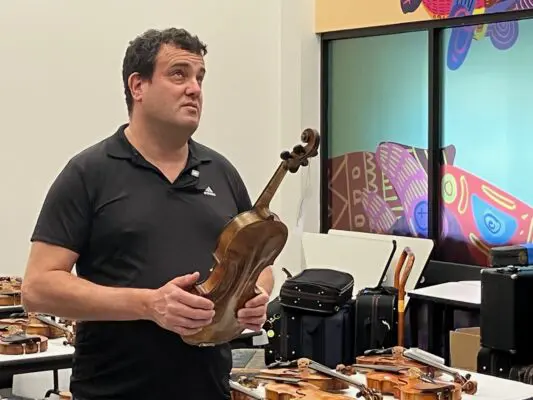
Violins of Hope project leader Avshi Weinstein, with the historic instruments at the Putnam Museum Feb. 16, 2026 (photo by Jonathan Turner).
Violins of Hope is a global project built around a private collection now totaling about 100 instruments, played in concerts and showcased in exhibits and educational programs worldwide, allowing music to carry forward stories of resilience and remembrance for today.
The first Violins of Hope concert was performed in 2008 in Jerusalem. The violins have traveled to and been played in major cities in Spain, France, Italy, Germany, Mexico, England, Romania, Poland and the United States.
Valuing culture and connection
“We are deeply proud to serve a community that values history, science, culture, and perhaps most importantly, human connection,” Putnam CEO Cindy Diehl Yang said Tuesday night. “The Violins of Hope project embodies all of those values. These instruments are far more than finely crafted violins. Each one carries a story. Each one once belonged to a Jewish musician whose life was forever changed by the Holocaust. Some were played in ghettos. Some in camps. Some were hidden away to survive. And through remarkable restoration, they now sing again.
“That act of restoration is powerful,” she said in remarks at the Putnam Giant Screen Theater, where a video on the project was shown. “It is an act of remembrance. It is an act of resilience. And it is an act of hope.
“As a museum, our mission is not only to preserve objects, but to preserve stories, especially the stories that challenge us, teach us, and inspire us to build a better future,” Yang said. “The Violins of Hope project does exactly that. Through exhibitions, educational programs, and performances, these instruments become teachers. They invite us to listen—to history, to survivors’ voices, and to one another. Together, we are ensuring that the stories carried by these instruments are heard by new generations. Projects like this reaffirm the importance of truth, empathy, and shared humanity.
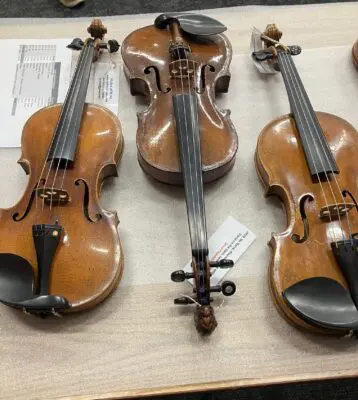
Three of the violins in the “Violins of Hope” exhibit, to be displayed at the Putnam Museum, Figge Art Museum, and German American Heritage Center + Museum in Davenport (photo by Jonathan Turner).
“I encourage each of you to engage deeply—with the exhibition, with the performances, and with one another. Ask questions. Reflect. Share what you learn with your families and your communities,” she said. “The impact of Violins of Hope does not end when the final note fades. It continues in conversations, in classrooms, and in the choices we make to stand against hatred and intolerance.”
Quad City Symphony executive director Brian Baxter introduced three student musicians (from the QCSO’s Youth Symphony Orchestra) – Bethany Priaulx, Haven O’Brian and Elise Brock — who each performed one of the historic violins, playing together at the theater.
QC student perspectives
Bethany, a homeschooled 9th grader, said played a violin that was thrown out of a train on the way to Auschwitz. “It’s really impactful for me because I’ve always been fascinated by history and just the fact that I’m actually holding this and it’s real. I don’t think it’s fully sunk in yet,” she said Tuesday.
“The train violin, the Auschwitz violin, the Haftel violin – all the stories fascinated me, and I couldn’t believe I was going to be able to perform on a Holocaust instrument that has carried the stories and heartache of all the musicians who’ve played on it. I still can’t,” Bethany said before the event.
“The violins’ histories touched me not just because I love music, but because I’ve always been fascinated with stories,” she said. “When I’m not playing violin, I’m usually reading a good book or writing one of my own. Stories from World War Two, and historical fiction in general, has always touched and inspired me. Now I get to tie music with history and bring one of these incredible violins to life. I’m so thankful for this opportunity. And I hope and pray I’ll be able to make the violin sing as best as I can, in honor of the musicians who have poured their heart out to it in the past.”
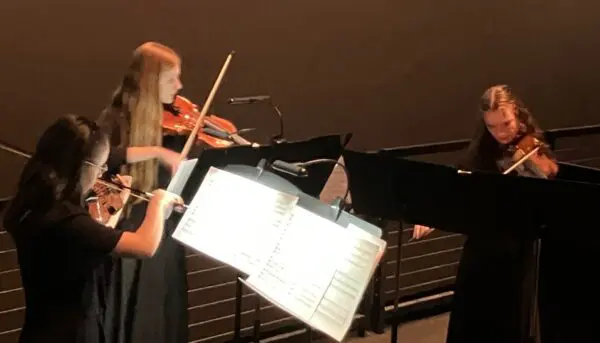
QC Youth Symphony Orchestra members Haven O’Brian, left, Bethany Priaulx and Elise Brock playing at the Putnam Giant Screen Theater Tuesday night (photo by Jonathan Turner).
Haven O’Brian, a 13-year-old student at Pleasant Valley Junior High, on Tuesday played a violin owned by a concertmaster named Heinrich Haftel, who helped start the Israel Philharmonic Orchestra. “And during the Holocaust, many Jewish musicians and their families were saved by being a part of this orchestra,” she said. “And I think that’s so powerful because it shows even in the darkest times, you can still come together and make something beautiful.”
“It didn’t just make music, it helped save lives,” Haven said. “It empowered others. It carries the true spirit of what music can be. Haftel was recruited with 100 musicians to help establish what became the Israel Philharmonic Orchestra (IPO) and to serve as its first concertmaster. Through the creation of the orchestra, many Jewish musicians and their families were saved. This is the legacy this violin represents: courage, leadership, and purpose.
“Playing Haftel’s violin as a young musician holds incredible weight that I cherish and hold to my heart,” she said. “It reminds me that music is not just something we perform. It’s something we can use. Haftel and the IPO shared music even in the middle of war, fear, financial hardship, and language barriers. They built something that gave people safety, identity, and a future. Today, so much divides us. Haftel’s story reminds me that unity is possible, and that music has always been one of the strongest ways to reach people.
“As a teenager in 2026, I’m holding an artifact that survived when so many others didn’t,” Haven said. “It is a true honor, and I am humbled to play Haftel’s violin and carry on his legacy. In a way, I feel chosen. I feel the responsibility to play well, to work hard, and to honor the history in my hands. But more than anything, I feel inspired. Haftel shows me what it looks like to use music to bring people together, to carry hope, to preserve memory, and to remind the world that beauty can survive, even in the darkest times.”
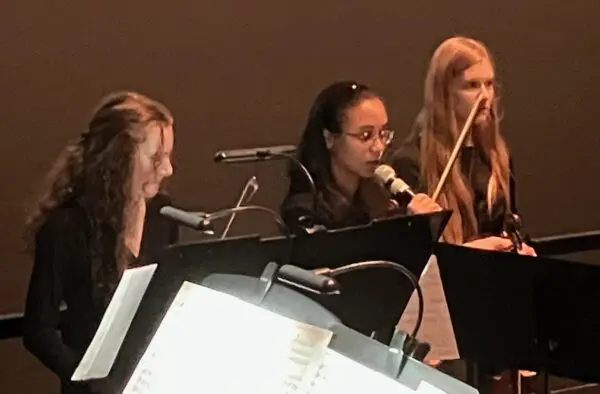
QC Youth Symphony Orchestra members Elise Brock, left, Haven O’Brian and Bethany Priaulx speaking during the “Violins of Hope” program at the Putnam Giant Screen Theater (photo by Jonathan Turner).
“The violin I’m playing is the Gypsy violin. And it’s really special to be able to play it,” said Elise Brock, a homeschooled 10th grader. “And it doesn’t really feel any different than a violin that was built last year. And it’s really crazy that it feels the same. It is a privilege and unique opportunity to be involved in a Violins of Hope event as a young musician. I am very grateful for the opportunity.”
QCSO musicians to visit schools
Baxter said that thousands of QC students will see some of the instruments up close, with visits from QCSO musicians, who will play them and discuss them. He told a story about Alma Rose (1906-1944), the niece of famous composer Gustav Mahler (who died in 1911), who led a women’s orchestra at Auschwitz.
“You think about a titan of music like Mahler and his niece ends up in the concentration camp,” Baxter said, noting Mahler was Jewish and converted to Catholicism to save his job. The QCSO Masterworks in April will perform his massive Sixth Symphony.
“It’s huge. It’s. It’s incredible. It’ll be overwhelming, but it’s just so emotional,” he said. “It’s really a triumph over adversity. Mahler was very much all about the entirety of the human experience in his music.”
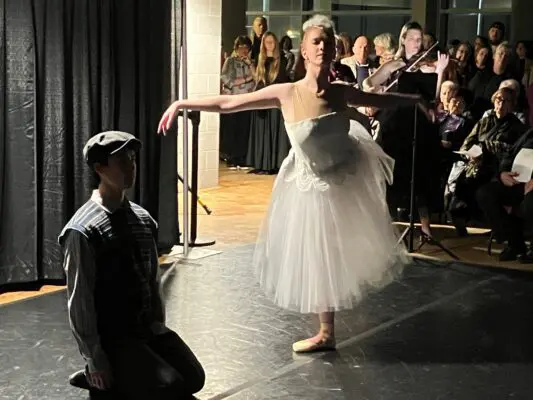
Ballet Quad Cities dancers Marcus Pei and Madeleine Rhode, accompanied by QCSO violinist Emily Nash, at the Putnam balcony, Feb. 17, 2026 (photo by Jonathan Turner).
The April 11-12 concerts also will include J.S. Bach’s Double Violin Concerto, for “Violins of Hope,” and the next weekend (April 18) will be a QCSO Up Close concert at the Figge Art Museum, featuring a special string quartet by Steve Reich, “Different Trains” (1988).
“It came from his childhood, Steve Reich’s childhood,” Baxter said, noting when he was one year old, his parents separated – his mother moved to Los Angeles and father stayed in New York City.
“And he traveled back and forth by train very frequently from New York to Los Angeles between 1939 and 1942. And he remembers his trips being sort of romantic and exciting, getting to take the train as a young boy across the country,” he said. “But when he looked back, in hindsight, he imagined, what if I had been in Europe during this period, he was Jewish, and he thought, well, I would be riding much different trains.”
Reich created this piece that reflects the juxtaposition of different trains, in three movements. “So it’s going to be a really powerful, moving piece, one of many really exciting events that are going to be happening here,” Baxter said. “Please check out all the events that we’re doing. There’s so much happening associated with Violins of Hope, and there’s so much to learn and so much to share, and I’m just grateful to be a part of it.”
Dancers and solo violin
Joseph Chonto of Davenport introduced the two solo pieces that QCSO violinist Emily Nash performed Tuesday night, accompanied by dancers of Ballet Quad Cities, on the Lardner Balcony of the Putnam.
“I think it is important to note that while these performances are memorials to tragedy beyond comprehension, they should be acknowledged primarily as affirmations, testimony that art, truth, freedom and human dignity have always, with great struggle and sacrifice, eventually triumphed over mendacity, bigotry, cruelty and evil,” Chonto said. “These pieces also serve as a warning and admonition that we cannot allow ourselves the false luxury of complacency by believing the past is somehow proof against the future. We must always be vigilant, recognize and bravely repudiate and resist these evil forces which lamentably are all too well and alive today throughout the world.”
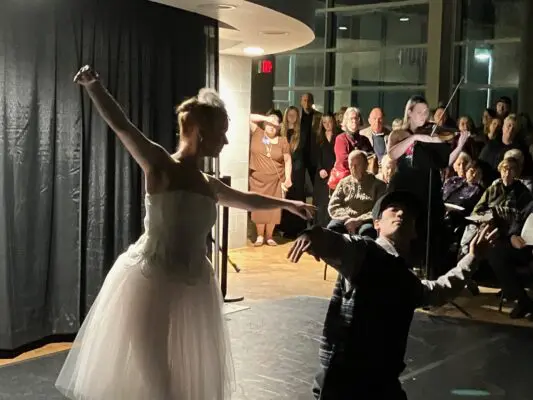
Ballet Quad Cities dancers Maddie Rhode and Marcus Pei performing for a Violins of Hope program at the Putnam, Feb. 17, 2026 (photo by Jonathan Turner).
“May these performances serve to strengthen our resolve to protect and further the pursuit of these noble ideals. We are so very fortunate to have violinist Emily Nash, associate concertmaster of the Quad City Symphony Orchestra, who will play both of the pieces live with the dancers. It was only a week ago that Ballet Quad Cities connected with Ms. Nash, who, upon hearing about Violins of Hope, immediately said yes.”
The score of Sandor Kuti’s Sonata for Solo Violin is unpublished, and Nash enlisted arranger and QCSO violist Bruno Vaz da Silva to make a transcription from the recording, and he also arranged Gideon Klein’s Fantasy and Fugue for Nash, which was originally composed for string quartet.
“Ms. Nash and Mr. Da Silva, of course, spent many hours working on these pieces, and she has traveled here from Chicago to perform tonight,” Chonto said. “Her and Mr. Da Silva’s extraordinary dedication is appreciated beyond description.”
The Kuti was danced by Madeleine Rhode and Marcus Pei, and the Klein by Madeline Kreszenz.
Violins of Hope will include major exhibits at the Putnam, the Figge, and German American Heritage Center and Museum, as well as performances by the QCSO (both Up Close chamber and full Masterworks programs), Ballet Quad Cities, and others.
QC partners in the project are ATLYS, Ballet Quad Cities, Eastern Iowa Community Colleges, Figge Art Museum, German American Heritage Center, Jewish Federation of the Quad Cities, Putnam Museum and Science Center, and the QCSO.
The QC events will culminate on Sunday, April 19, 2026 with the Yom Hashoah – 45th Annual Holocaust Remembrance, at 7 p.m. at the Rogalski Center, St. Ambrose University, Davenport.
“With rising antisemitism and other forms of hate worldwide, the message of resistance, resilience and hope that these instruments bring is relevant for today and is the reason the QCSO feels so passionately about bringing this experience to Iowa communities,” Baxter said.
For a complete schedule of events and more information about Violins of Hope Iowa, visit violinsofhopeiowa.com.







Leave a Reply
You must be logged in to post a comment.